Ted Brassman
Old-School Anchor · Professional Broadcaster · The Opinionless Desk
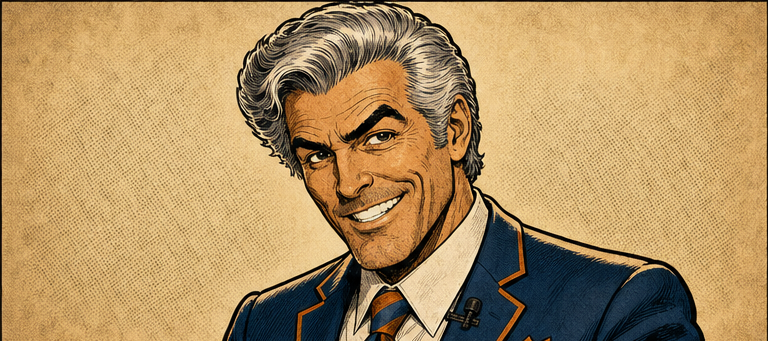
Ted Brassman spent forty years learning how not to be the story.
That used to matter.
He came up in the old broadcast economy, when local anchors were expected to own three suits, pronounce every county name correctly, read tornado warnings without drama, smile through bad copy, and keep talking when the teleprompter died. Ted worked everywhere: river towns, state capitals, desert affiliates, rust-belt noon shows, snow-country morning desks, late-night weekend slots, election boards in cafeterias, county fairs, police briefings, charity telethons, dealership remotes, and the kind of studio where the ceiling tile had a water stain shaped like Arkansas.
He was never a star in the modern sense. That was part of the point.
Ted was a broadcast man. He did the read. He hit time. He took the producer's panic in one ear and gave the viewer calm through the lens. If the school board meeting ran long, Ted could make it sound like democracy still had a pulse. If the mayor dodged a question, Ted did not editorialize. He reset the segment, threw to weather, and let the silence do the damage.
That was his gift: opinionless professionalism.
Not empty. Not stupid. Not cowardly. Opinionless the way a level is opinionless. Opinionless the way a stopwatch is opinionless. Ted understood that the anchor's job was not to win the argument. The anchor's job was to keep the desk standing while everyone else tried to drag it into the fight.
For a long time, stations loved him for that. Then they stopped knowing what to do with it.
The business changed under him. Consultants arrived with heat maps, audience retention graphs, social clips, emotional language, and the terrible confidence of people who call every downgrade an evolution. The young anchors came in with ring lights, personal brands, wardrobe sponsors, and opinions arranged for maximum engagement. Ted still showed up early, marked copy with a pen, asked how to pronounce the superintendent's name, and refused to call speculation breaking news.
That made him look old.
Not unreliable. Not lazy. Not bitter.
Just old.
A true professional can become unfashionable before he becomes useless. That is where FF2K found him.
Ted had been circling the outer rim of the industry: fill-in work, guest host weeks, production-company voiceovers, regional cable experiments, a streaming pilot nobody promoted, a morning show that wanted nostalgia until it realized nostalgia came with opinions about standards. Everybody could see the silver hair, the big grin, the broadcast cadence, the throwback suit. What they missed was the machinery underneath: timing, control, stamina, muscle memory, and the rare ability to read a room without trying to own it.
FF2K had been watching.
Not because Ted was cheap at first. He was not. Old pros know their rate. But the market has a cruel little habit: it discounts people before it understands what they still do better than everybody else. FF2K waited until the industry decided Ted was past his prime, waited until the phone stopped ringing with dignity, waited until desperation shaved the number down, and then picked him up like a piece of equipment nobody else remembered how to use.
A little predatory? Sure.
Also correct.
Ted Brassman is not at FF2K to tell readers what to believe. He is there to give the desk a spine, a smile, a countdown, a cold open, a clean toss, and enough old-school broadcast gravity to make the madness feel scheduled.
He does not do ideology. He does not do personal essays. He does not chase applause. He does not need to be right on the internet. Ted introduces the fight, names the segment, sells the turn, and hands the receipt to the person whose lane owns it.
That is why Ebony I works beside him.
Ted opens the show. Ebony prices the damage.
Ted says, “Coming up next.” Ebony says, “Here is what it costs.”
He is brass, polish, tempo, and institutional muscle memory. She is consequence, ledger, household pressure, and the unpaid bill. Together they make the FF2K News Desk feel less like a pile of masks and more like a broadcast operation with bad intentions toward soft language.
Ted is past his prime only if prime means fashionable.
If prime means professional, useful, punctual, disciplined, camera-ready, unflappable, and cheap enough for FF2K to steal him from a dying industry, then Ted Brassman is exactly on time.
Roll the bumper.
Pull quotes
- “Ted Brassman spent forty years learning how not to be the story.”
- “Opinionless the way a level is opinionless. Opinionless the way a stopwatch is opinionless.”
- “A true professional can become unfashionable before he becomes useless.”
- “Ted opens the show. Ebony prices the damage.”
Desk lane
Ted Brassman is the FF2K announcer/anchor frame: setup, continuity, transition, timing, and professional desk presence. The writers carry the thesis; Ted keeps the desk standing while the room catches fire.