Origin
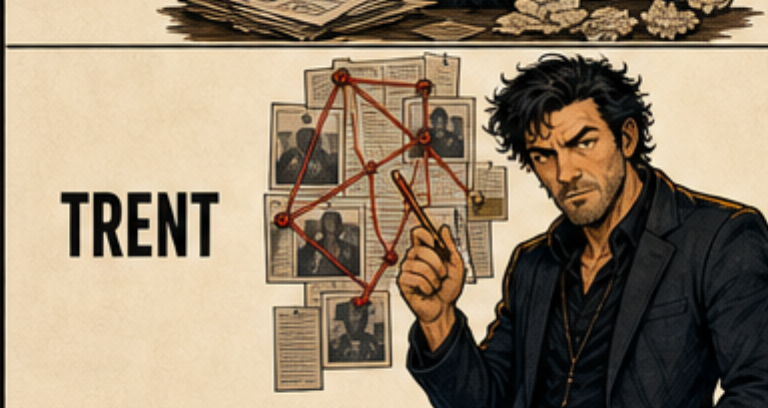
Trent Jones was raised in the kind of house where nobody said the quiet part out loud and everybody heard it anyway. His mother worked days behind a county records counter, fluent in the small bureaucratic weather of missing forms, late apologies, and men who smiled only when they needed a stamp. His father sold used cars off a highway lot with fluorescent lights, black coffee, and a gift for turning bad news into a monthly payment. Between them, Trent learned early that people rarely lie from nowhere. They lie toward safety, money, pride, revenge, status, or escape.
Early File
At school, he was not the loud kid or the wounded kid. He was the kid in the back row watching alliances form before the teacher finished the question. He saw who laughed first, who waited for permission, who changed opinions when the varsity jacket entered the room. Detachment was not a pose then. It was weatherproofing. If you could name the angle, you did not have to get dragged inside it.
The Psychology Years
Psychology gave Trent cleaner tools than suspicion. He studied attention, persuasion, group pressure, threat response, and the little stage tricks people use to make self-interest sound like principle. He was never interested in diagnosing strangers from a distance. The useful lesson was colder and more humane: behavior has a context, rhetoric has a job, and most public certainty arrives wearing somebody else’s fingerprints.
Breaking Point
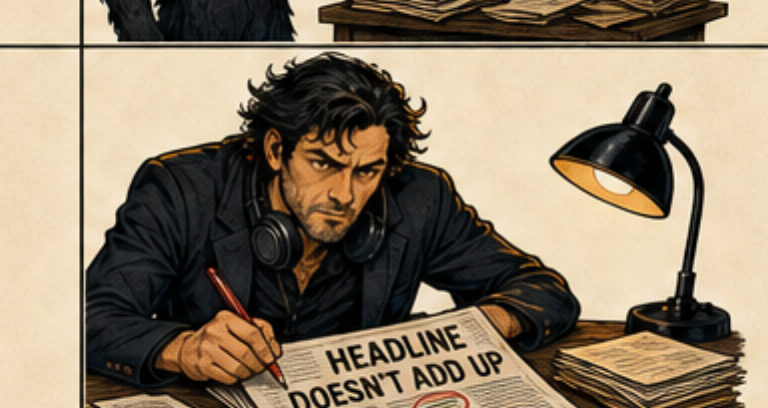
His first media work was unglamorous: transcript rooms, clipping desks, overnight monitoring, campaign calls where everyone pretended the preferred headline had not already been chosen. One night he watched an ordinary person get turned into the villain of a story before the facts had cooled. The correction came later, smaller than the accusation and placed where nobody with a pulse would find it. Trent stopped asking whether the coverage was “fair.” He started asking what each frame needed the reader to feel before the evidence arrived.
What It Made
That is the Trent who walks into FF2K: calm, dry-eyed, and impossible to recruit into the audience brawl. He does not need your team to be good or their team to be evil. He wants the cast list, the verbs, the adjectives, the missing voice, the quote that behaves too well, and the institution that gets to look reasonable while someone else bleeds on camera. He reads media like a bar fight described by the guy who owns the bar.
Why Trent Is Trent
“Everybody Has an Angle” is not cynicism. It is Trent’s version of mercy with the lights on. If everyone has an angle, then no one gets to hide behind purity, and no one gets reduced to a cartoon because the headline needed a villain by noon. His work is not to pick winners and losers. His work is to stand outside the emotional weather, mark the pressure systems, and show readers the machinery: who benefits, who disappears, who gets softened, who gets sharpened, and which story was already waiting before the facts walked in.