 Trent Jones · Everybody Has an Angle · June 28, 2026
The original Bitcoin pitch was not polished.
It asked people to do difficult things. Run a node. Hold keys. Verify. Back up a seed phrase. Accept that there would be no help desk if they turned personal responsibility into confetti.
That was not a bug in the story. That was the story.
Then the professional class arrived with a better lobby.
They did not say Bitcoin was wrong. They said Bitcoin was inconvenient. They said the average buyer did not need the full burden of ownership. The buyer needed access. A familiar account. A ticker. A custodian. A product that could sit inside the old system without frightening the committee that approves allocations.
The word they settled on was exposure.
Exposure is a careful word. It sounds close enough to ownership to inherit the excitement, and far enough from ownership to keep the buyer inside the institution.
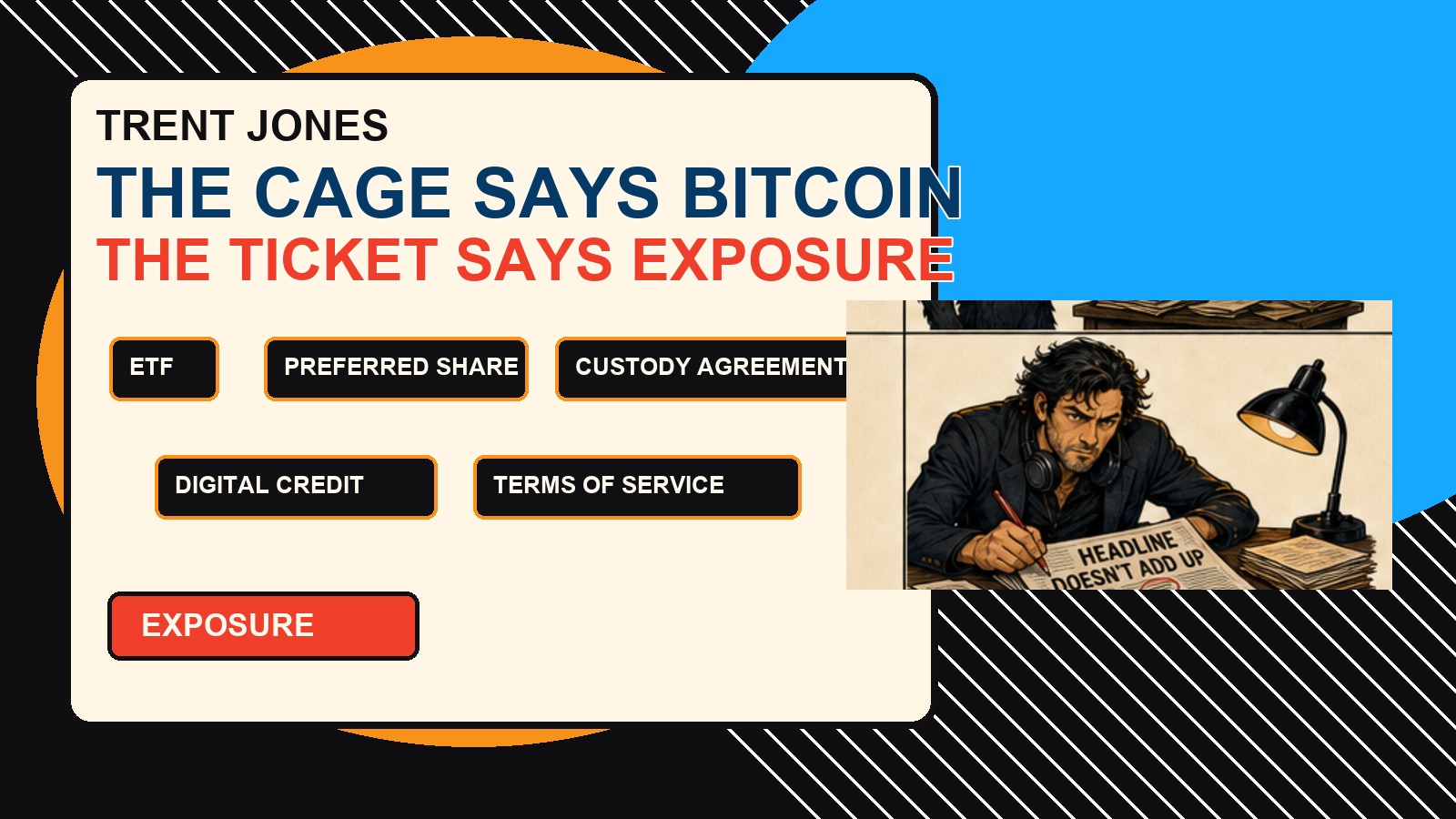
That is the handoff Skip's cartoon caught. The coin is still there. The glass case is new. The ticket window is open.
The old bargain
Bitcoin mining is a physical argument. The network pays a fixed subsidy, currently 3.125 BTC per block, plus fees. Miners compete for it with power, machines, cooling, land, debt, maintenance, and operational discipline. Difficulty adjusts. Weak margins get punished. Nobody gets to talk a block into existence.
A self-custody holder accepts a different burden. No warehouse. No ASIC fleet. But also no custodian to blame. The private key is the relationship. That is why the phrase 'not your keys, not your coins' lasted. It compressed the whole ethic into one sentence.
That ethic did not scale politely into the brokerage window.
ETFs, treasury companies, preferred-stock wrappers, and digital-credit products solve a real distribution problem. They give institutions and ordinary investors a way to participate without touching keys. Some buyers need that. Some buyers want that. Some rules require that.
Fine.
But participation is not the same relationship as possession.
The Saylor machine
Strategy is the cleanest case because the numbers are too large to hide behind theory.
The company reported 818,334 BTC as of May 3, 2026. Public tracking and later purchase disclosures put the stack higher, around the mid-800,000 range. At the current post-halving subsidy, 450 new BTC per day, that is roughly five years of new mined subsidy sitting inside one public-company balance sheet.
Strategy did not mine those coins. It financed them.
Its own filings describe the machinery: common-stock at-the-market offerings, preferred stock, convertible notes, and other capital-market instruments. The miner competes for block rewards. Strategy competes for investor appetite. One burns electricity. The other burns narrative, premium, and access to capital.
That does not make the coins fake.
It makes the route into the coins different enough to matter.
When a company can absorb years of new issuance through securities-market demand, the old mining signal starts sharing the stage with a different signal. Miner stress still matters. Hashprice still matters. Difficulty still matters. But the price and the story can be pulled by financial wrappers that do not carry the miner's cost structure.
The result is not counterfeit Bitcoin. The result is financialized proof-of-work.
The zoo
A zoo does not need fake animals to change the visitor's relationship to the animal.
The animal can be real. The bars can be real. The ticket can be real. The sponsor can be real. The experience can still be the opposite of wilderness.
That is the metaphor here.
A Bitcoin ETF may track price. A treasury company may hold coins. A preferred share may offer a cash yield supported by a Bitcoin-heavy balance sheet. A custodian may be legitimate. A prospectus may disclose the risks. None of that proves fraud.
But it also does not recreate Bitcoin's original promise.
The promise was exit. The product is access.
The promise was verification. The product is disclosure.
The promise was bearer ownership. The product is exposure.
The promise was no trusted intermediary. The product is an intermediary with better typography.
Why the distinction matters
The distinction matters because adoption statistics can lie without using false numbers.
If more institutions buy Bitcoin exposure, Bitcoin adoption rises in one sense. If fewer people learn to hold keys, run nodes, or understand settlement, Bitcoin adoption may be thinning in another sense. The number goes up. The relationship gets weaker.
That is why the miner economics question connects to the custody question. Miners still produce the asset through work. Financial firms produce access to the asset through paperwork. Once the paperwork becomes the dominant onboarding path, the public may confuse the wrapper for the thing inside it.
Wall Street is good at that. It has been turning hard things into soft claims for a very long time.
Again, this is not an argument that wrappers are useless. A serious market will have custodians, funds, treasury companies, lenders, preferreds, derivatives, and disclosures. The adult world arrives with folders. Pretending otherwise is theater.
The point is simpler: the folder is not the key.
The question for the reader
The reader does not need to be told whether the zoo is good or bad.
The reader only needs to notice who built it, who sells admission, who owns the glass, who writes the terms, who feeds the animal, and who is no longer allowed to touch it.
Bitcoin did not have to be broken for this to happen.
It only had to become valuable enough for the old system to put it behind glass.
The cage says Bitcoin.
The ticket says exposure.
- Trent Jones