Your Wallet Is Temporary. Your Seed Is the Savings Technology.
What firmware archives, DIY signers, smartcards, and too many recovery drills taught me about the only part that really has to survive.
I spent the last couple of weeks archiving COLDCARD firmware, wiring a SeedSigner on a breadboard, researching JavaCards and waiting for a smartcard HAT to arrive in the mail.
Naturally, this made my self-custody setup simpler.
That is a lie.
It did make one thing clearer: I care less about which hardware wallet wins this year's beauty contest than I care about the quality of the seed underneath it.
A hardware wallet is a tool. Tools break, companies disappear, download links rot and tiny plastic camera connectors snap if you look at them with the wrong attitude. The seed is the thing that has to outlive all of that.
Start with entropy, not branding
A properly generated 24-word BIP39 mnemonic begins with 256 bits of entropy. BIP39 adds an eight-bit checksum and converts the result into 24 words selected from a standardized list.
The number of possible 256-bit values is:
115,792,089,237,316,195,423,570,985,008,687,907,853,269,984,665,640,564,039,457,584,007,913,129,639,936
People like to describe that as picking one atom from the observable universe. The literal estimate for atoms is closer to 10^80, while 2^256 is about 1.16 × 10^77.
So the analogy is off by roughly three zeros. This will be deeply comforting to the burglar planning to search a hundred trillion trillion trillion trillion trillion trillion trillion possibilities before lunch.
The point survives the bar-fight math. If the entropy was generated honestly, offline and without bias, nobody is guessing that seed.
But "256 bits" printed on a box proves nothing. If the device's random-number generator is defective, the firmware substitutes weak randomness, or you make up words because they feel lucky, the giant number is theater. And if you photograph the finished mnemonic and upload it to the cloud, congratulations: you converted 256 bits of entropy into one customer-service ticket.
Seed quality is established at creation. Use a method you understand: a reviewed hardware random-number generator, enough fair dice rolls processed correctly, or independently sourced entropy combined by software you can verify.
Longer does not repair stupid. A properly generated 12-word BIP39 mnemonic has 128 bits of entropy and remains beyond brute force. I prefer 24 words for deep savings because I can handle the backup burden, not because twelve good words became a scratch-off ticket.
Verify the seed, not just the spelling
Once I have generated a seed, I want to recover it on two or three offline devices built from independent implementations. A manufactured hardware wallet. A stateless SeedSigner. A Specter DIY. Whatever combination makes sense, as long as I am not testing three copies of the same bug wearing different cases.
I compare the wallet fingerprint and the first receiving addresses. I confirm the BIP39 passphrase, derivation path and wallet descriptor when applicable. Twenty-four correct words with the wrong passphrase produce a perfectly valid wallet containing precisely none of my money. Bitcoin is helpful like that.
This cross-check does not prove the original randomness was good. It proves I recorded the mnemonic correctly and that independent devices derive the wallet I expect. Entropy quality is proven during generation. Recoverability is proven by recovery.
Then I wipe the devices and do it again.
That last part matters. A backup you have never restored is a religious belief.
Fluency is part of custody
BIP39 is valuable because the mnemonic is portable. It is not married to the little screen that created it. Compatible wallets can reproduce the same underlying seed, although passphrases, derivation paths and address formats still need to be documented.
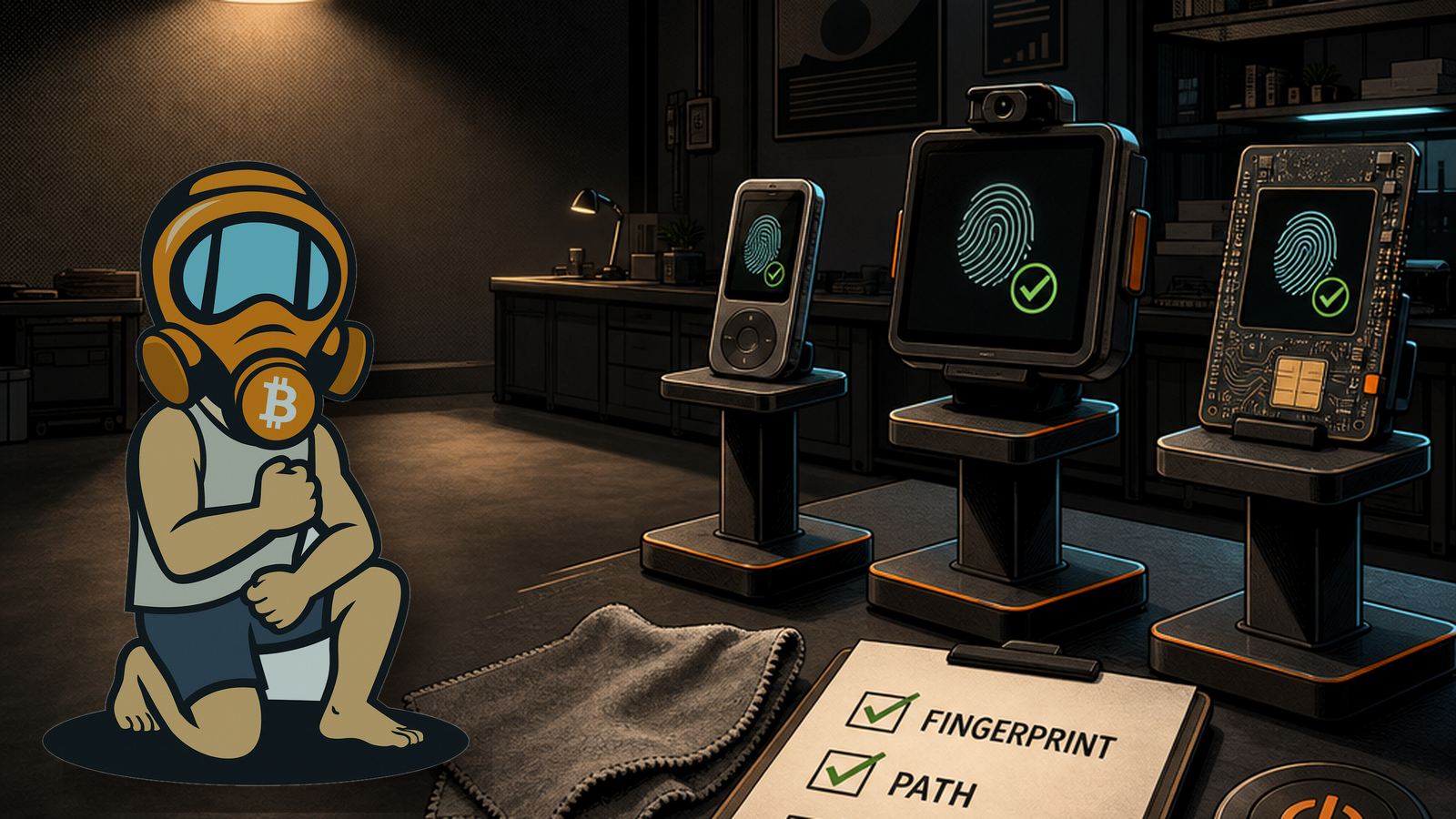
This is why I have been screwing around with DIY signers, manufactured hardware wallets and smartcards. I want enough experience that losing one device is an inconvenience, not a hostage negotiation.
Can I load the seed into a stateless device? Verify an address? Sign a PSBT? Wipe it? Recover on something made by another company? Can my future self do it after not touching the setup for three years?
If the answer is no, I do not have self-custody. I have a scavenger hunt designed by a younger version of myself.
Match the wallet to the spending
Bitcoin is savings technology. The way I access it should reflect how often I intend to spend it.
Deep savings should be inconvenient. The seed belongs on steel in separate locations, with the passphrase separated if one is used. A stateless signer can be assembled or loaded only when needed. The friction is a feature. I do not need my retirement savings ready to buy tacos in eleven seconds.
Money I may move occasionally can live behind a dedicated hardware wallet or a PIN-protected smartcard, provided the seed remains independently recoverable.
Regular spending belongs in a smaller warm wallet with an amount I can afford to expose. Making every coffee purchase a cold-storage ceremony is how people eventually start taking shortcuts.
The seed does not change because the spending device changes. That is the beauty of it. The hardware is replaceable. The interfaces are replaceable. Vendors are replaceable.
What matters is that the original entropy was real, the secret stayed secret, and I practiced recovery until it stopped feeling exotic.
I am still going to archive firmware. I am still going to test smartcards, meter breadboard switches and stamp the seed into steel. I enjoy overbuilding things. It is cheaper than golf.
But the hardware is not the savings.
The seed is the savings. Everything else is how often I plan to touch it.
— FF2K