NOTICE TO EVERYONE HOLDING A SCREENSHOT AND HALF A LAW DEGREE: The warehouse, its owners, the meetings, the payments, the sales scheme, and every private conversation in this story are fictional. Real names appear only alongside public facts and statements. This is satire, not an allegation that Luke Dashjr or any other real person took money, conspired with miners, or committed a crime. If you skip this paragraph and become furious anyway, congratulations: you have been selected for jury duty.
Ladies and gentlemen of the jury, Bitcoin Core has been captured.
Captured by whom?
That part changes every eleven minutes.
Sometimes it is the corporations. Sometimes it is the foundations. Sometimes it is venture capital. Sometimes it is the Ordinals people, who apparently seized the GitHub repository using JPEGs of wizards. By Thursday afternoon it may be Luxembourg.
The prosecution offers a different theory.
Not a true theory. A much better one.
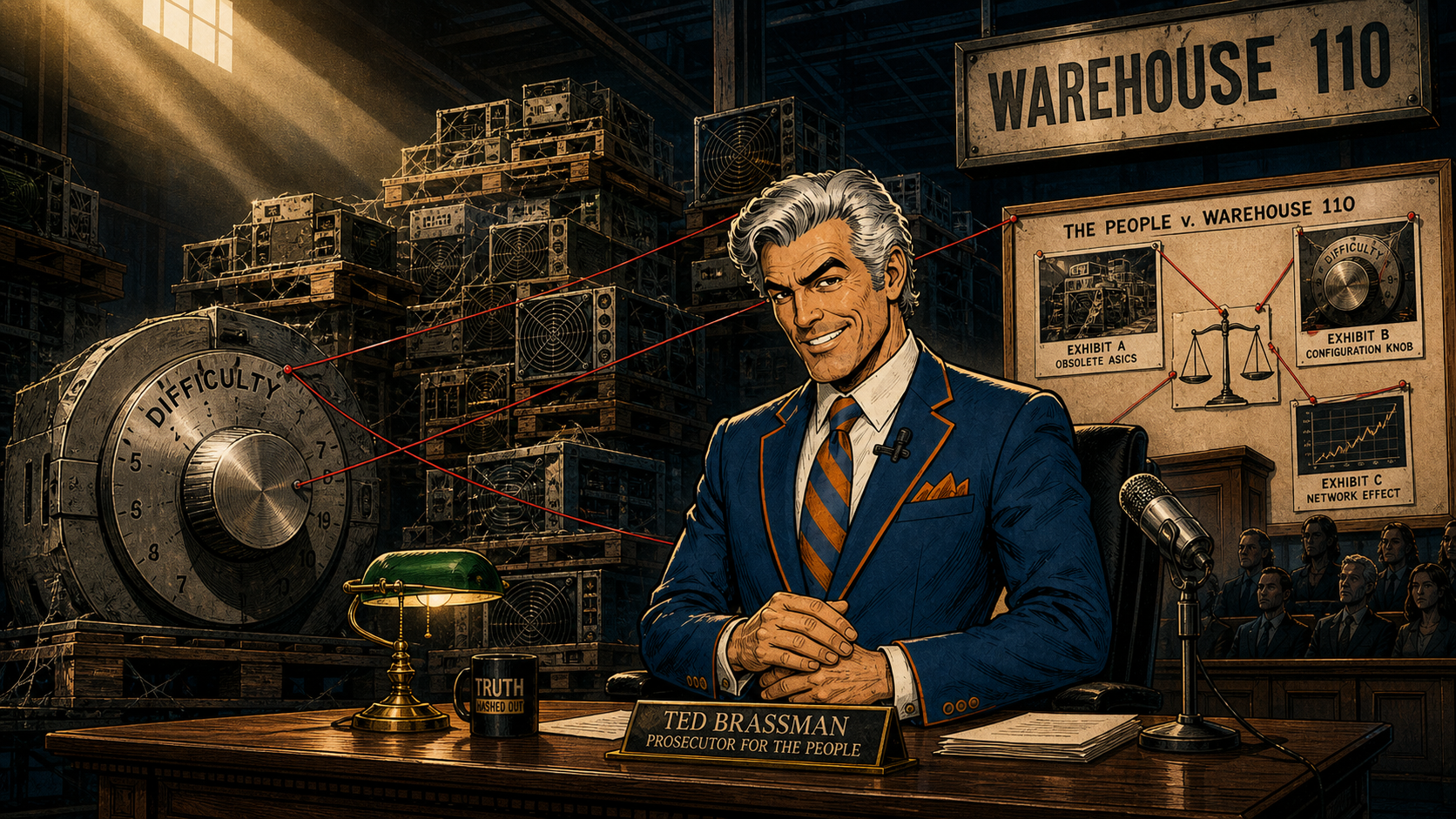
This case is about a warehouse.
Opening statement
Somewhere in a humid industrial park, behind a vape wholesaler and a company that imports suspiciously cheap patio furniture, sat Warehouse 110.
Inside were seventeen thousand obsolete Blake2b ASIC miners.
They were not broken. Broken equipment has dignity. These machines were perfectly capable of doing the one job for which they had been built, except nobody wanted that job anymore. They sat on pallets humming the saddest song in capitalism: inventory carrying cost.
The warehouse owners had tried everything.
They listed the miners on eBay as "vintage decentralization hardware." No bids.
They offered them to a museum. The museum asked them to stop calling.
They renamed the product "sovereign compute." Still nothing.
Then one owner looked at Bitcoin, looked at the pallets, and asked the question that has launched every great crypto business model:
"Could we make this somebody else's emergency?"
The State will prove that they could.
Again, not the actual state. This entire prosecution is fictional. Our budget is one folding table and a laser printer with a cyan problem.
Exhibit A: the coins
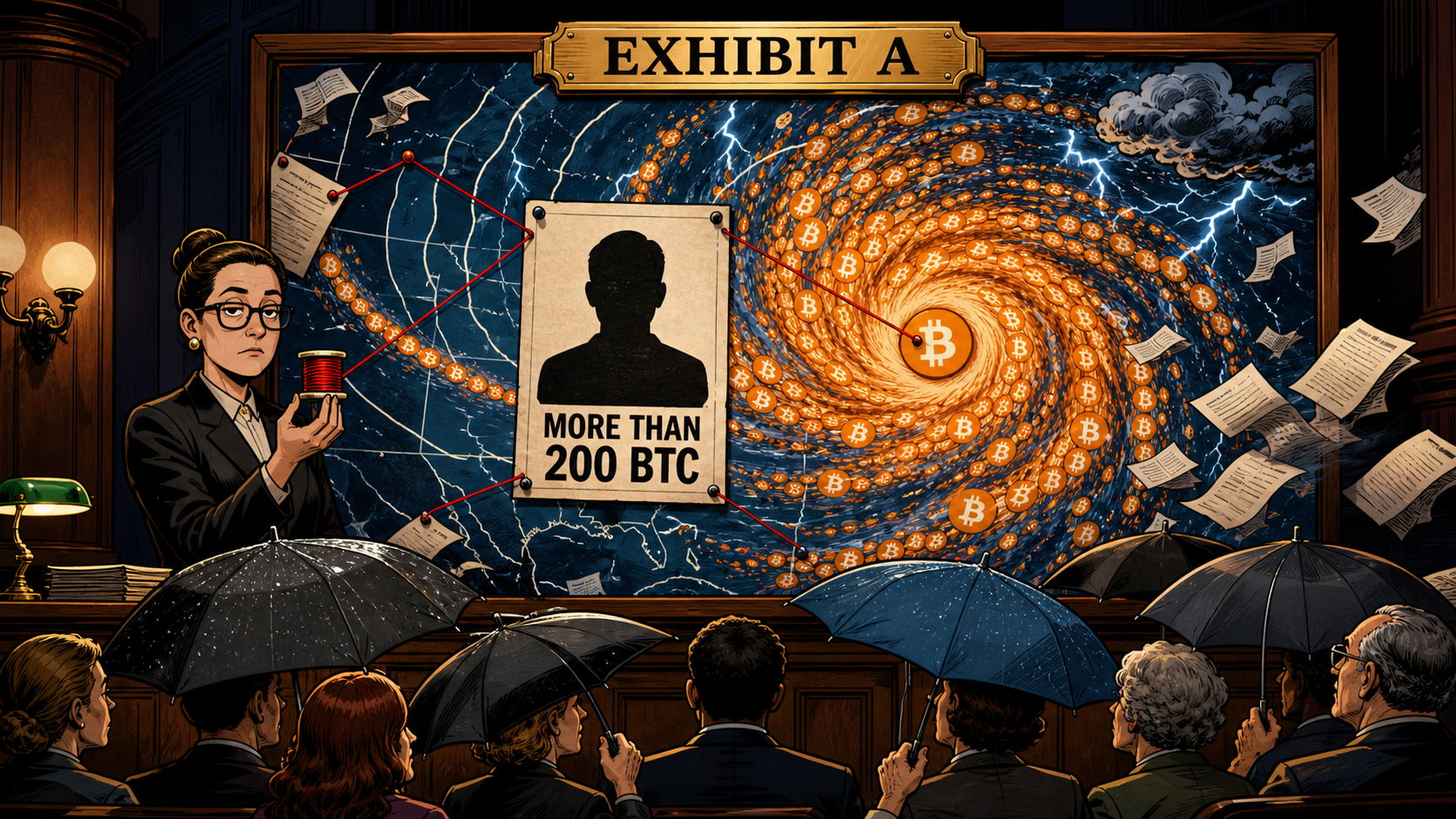
In January 2023, Luke Dashjr publicly reported that an attacker had compromised his PGP key and stolen more than 200 BTC.
That is a real event and a brutal one. Losing that much bitcoin would change a man. It would change most men into a weather system.
The prosecution is not claiming the theft caused anything that followed. The prosecution is merely placing a red string between two unrelated pushpins because this is a conspiracy story and we have standards.
Still, imagine the fictional sales pitch.
A black SUV arrives. Two men step out wearing mining-pool polo shirts and the facial expression of people who have depreciation schedules.
"Luke," says the taller one, opening a briefcase containing nothing but an electricity bill, "we understand you have recently developed an interest in recovering value from technically valid objects that the market no longer recognizes."
Objection.
Savage.
Sustained.
Exhibit B: the knob
Bitcoin Core changed its default OP_RETURN relay policy in version 30. The change did not make previously invalid transactions valid. It changed the default policy for relaying and mining consensus-valid transactions. Operators who disliked the new default could change the setting themselves.
In other words, there was a knob.
A real knob. A documented knob. A knob available to any node operator with a keyboard and the emotional stability to edit a configuration file.
But "I changed my local policy setting" is not a movement. It does not get a logo. Nobody produces a dramatic countdown video for datacarriersize=83.
So the knob became a constitutional crisis.
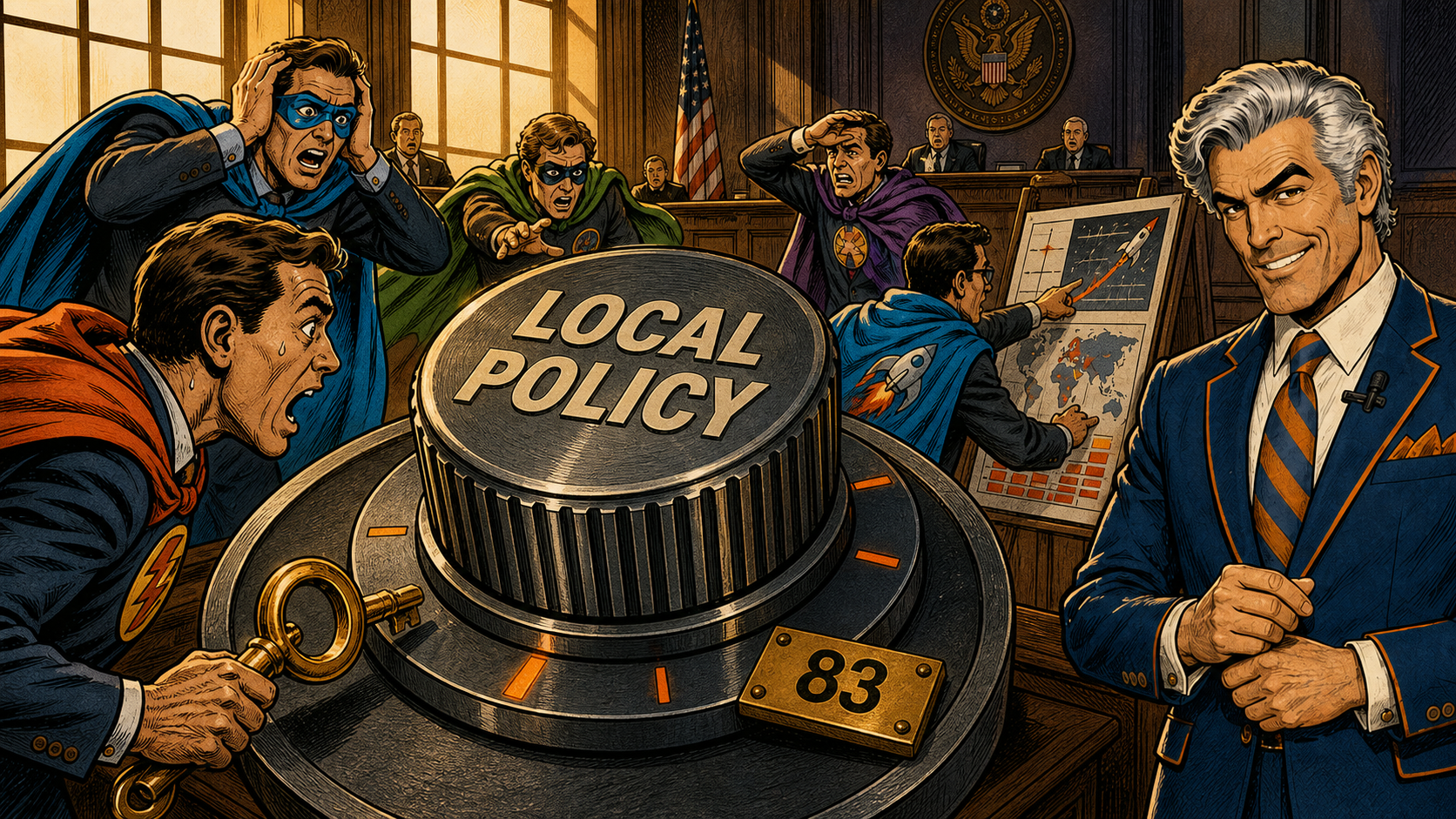
Core said the policy was local.
Critics said the default carried enormous influence because most users do not customize policy.
Both statements can be true. This was unacceptable. The internet requires one tribe to be Satan before lunch.
Warehouse 110 saw its opening.
Exhibit C: BIP-110
BIP-110 proposed a temporary soft fork restricting several methods of embedding arbitrary data in Bitcoin transactions. It was authored by Dathon Ohm, not Luke Dashjr. Luke maintained Bitcoin Knots, which shipped enforcement code and became the most visible implementation behind the effort.
The proposal reached its mandatory-signaling window in August 2026. Miner support was nowhere near the early lock-in threshold. A signaling branch and a non-signaling branch split. The ordinary SHA-256 branch accumulated substantially more proof of work while BIP-110-enforcing nodes remained on the minority branch.
Luke's public position was not, "Well, that went poorly."
His position was that BIP-110 activated successfully and that the greater-work branch was a hostile hard-fork attempt trying to steal the Bitcoin name for a CBDC.
This is an extraordinary claim. It is also public, which means the prosecution does not have to invent it. Frankly, that takes some of the fun out of our job.
When Knots users asked to rejoin the greater-work chain, Luke wrote that miners do not decide the rules, hashpower is not king, and Knots would not cooperate with the attack.
Ladies and gentlemen, that is not backing away from the fork.
That is standing beside a smoking crater and accusing the undamaged road of leaving you.

Exhibit D: the algorithm department
After the split, discussion turned to changing proof of work so the minority chain would no longer depend on the SHA-256 miners it viewed as hostile. Luke had already written publicly that if BIP-110 did not pan out, "the only option is a PoW change." On August 12, one secondary report said he had selected BLAKE2b.
This is where our fictional warehouse manager, Mr. Dale "New Old Stock" Pritchard, nearly swallowed his cigar.
"BLAKE2b?" he whispered.
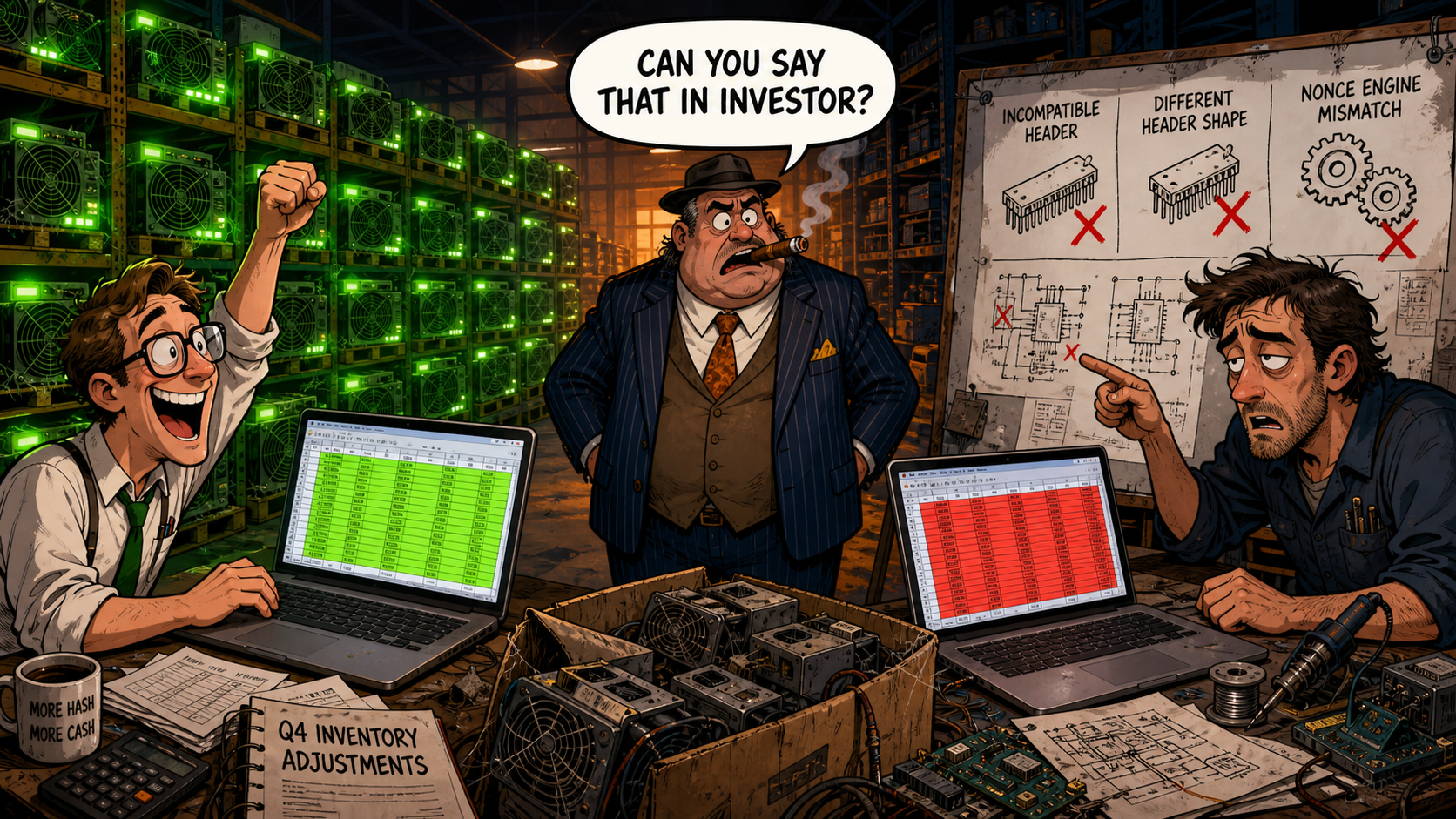
His accountant slowly opened the warehouse inventory spreadsheet.
Rows turned green.
Sia already used BLAKE2b before its 2018 ASIC hard fork. The fork did not replace BLAKE2b with a different hash. It added a nonce-divisibility rule at block 179,000 that Obelisk hardware had been designed to handle. Conventional Bitmain and Innosilicon machines lost roughly 1,008 out of every 1,009 nonce attempts on the upgraded chain. They did not burst into flames. They became economically useless there, which is the ASIC version of being alive during your own estate sale.
Now picture those displaced machines years later, stacked in Warehouse 110 beneath tarps and a banner reading:
NOT OBSOLETE. EARLY FOR THE NEXT MONETARY REVOLUTION.
Mr. Pritchard called an emergency meeting.
"Gentlemen," he said, "we don't need to sell miners to a coin. We need to sell a coin to the miners."
The room went silent.
Someone began designing a conference badge.
Then the firmware engineer raised his hand.
"Same hash family doesn't mean these boxes can mine an arbitrary BLAKE2b chain. The block header, nonce rules, digest construction, and job protocol all have to match."
Mr. Pritchard stared at him.
"Can you say that in investor?"
"The pallets may still be useless."
The accountant changed the rows back to red.
This was disappointing but not fatal. Crypto has never required the product to work before the conference badge is printed.
The alleged conspiracy, which is fictional, calm down
The fictional plan had five steps.
Step one: Turn a configurable relay-policy default into proof that Bitcoin Core had been captured.
Step two: Promote a consensus fork as the only moral response to a setting users could already change locally.
Step three: If the fork failed to attract SHA-256 hashpower, declare SHA-256 hashpower the attacker.
Step four: Change the proof-of-work algorithm to one supported by pallets of previously worthless hardware.
Step five: Sell every miner in Warehouse 110 as a "Founder's Edition Bitcoin Restoration Node" for four times scrap value.
A free trucker hat would be included with orders of fifty or more.
The genius was not technical. It was linguistic.
The losing chain was "Bitcoin."
The chain with the proof of work was "the hostile fork."
The obsolete ASIC was "specialized security infrastructure."
The warehouse liquidation was "grassroots monetary defense."
And the invoice was denominated in dollars, because satire can only carry so much weight.
Witness for the defense: Bitcoin Core
Counsel for the defense calls Bitcoin Core to the stand.
"State your occupation."
"Open-source software project."
"Have you been captured?"
"By whom?"
"Please answer yes or no."
"That's not how distributed development works."
"Your Honor, permission to treat the witness as technically correct and socially unbearable?"
Granted.
Core's defenders are right that relay policy is not consensus. They are right that operators can change the setting. They are right that miners can receive consensus-valid transactions privately even when public relay nodes reject them.
Core's critics are also right that defaults matter. A dominant client's defaults shape what most of the network does without touching a configuration file. Pretending defaults have no political weight because they are not consensus rules is like saying the thermostat does not control the building because every tenant is legally permitted to open a window.
There was a real argument here.
Then everybody put on a cape.
Cross-examination of the capture narrative
If Bitcoin Core is captured, the prosecution has several questions.
Who captured it?
What did they obtain?
Which decisions prove the capture rather than merely prove disagreement?
What evidence would falsify the claim?
Why does the remedy for a disputed default require everyone else to adopt new consensus rules?
And why, after the market rejected the fork, did the definition of "Bitcoin" suddenly stop including accumulated proof of work?
A capture theory that cannot name the captor, trace the consideration, identify the mechanism, or survive contrary evidence is not an indictment.
It is Mad Libs for people with hardware wallets.
The prosecution's closing argument
Nobody has produced evidence that a secret warehouse of obsolete Sia miners financed BIP-110, paid Luke Dashjr, engineered the OP_RETURN dispute, or pushed a Blake2b fork to rescue stranded ASIC inventory.
We made that up.
But that is the point.
It took us one afternoon to build a conspiracy theory with a motive, hardware, historical parallels, a distressed protagonist, a policy dispute, a failed fork, and seventeen thousand machines waiting for their Rocky montage.
It even has better internal accounting than most capture stories.
The evidence does support a less cinematic conclusion.
Bitcoin Core changed an influential default. Critics reasonably objected. BIP-110 escalated that dispute into consensus rules. Miner support did not materialize. The network split. The greater-work branch kept moving. In the prosecution's view, some supporters publicly framed that outcome as an attack and discussed changing the game board.
No warehouse is required.
No bribe is required.
No secret cabal is required.
Human beings can produce this result using pride, ideology, sunk costs, group chats, and the ancient inability to say, "We lost."
That theory is less exciting.
It is also undefeated.
The People rest.
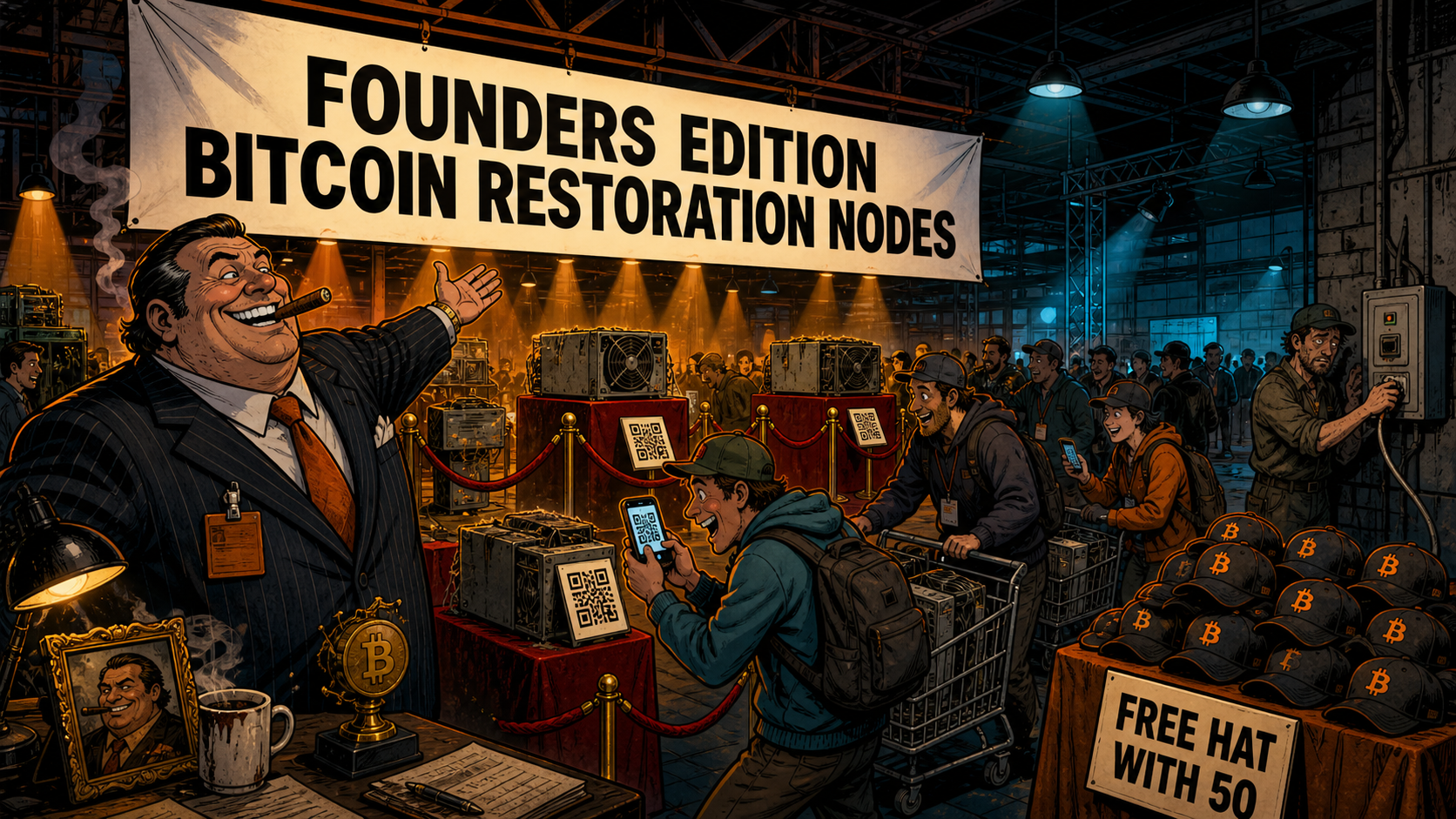
Warehouse 110 is now accepting preorders.
Fact docket
The satire above rests on these public facts. The conspiracy does not.
- Luke Dashjr publicly reported a PGP compromise and theft of more than 200 BTC in January 2023.
- Luke Dashjr is the maintainer of Bitcoin Knots.
- Bitcoin Core 30 changed the default OP_RETURN relay/mining policy; operators can configure a different local limit.
- BIP-110 was authored by Dathon Ohm as a temporary consensus soft fork. It did not itself propose a PoW change.
- Bitcoin Knots shipped BIP-110 enforcement. The mandatory-signaling window produced a chain split in August 2026 with the non-signaling branch accumulating far more proof of work at the measured cutoff.
- Luke publicly characterized the greater-work branch as a hostile hard fork and rejected requests for Knots to rejoin it.
- Luke publicly wrote on August 5, 2026: "If BIP110 doesn't pan out, the only option is a PoW change." On August 12, secondary reporting said he had selected BLAKE2b. The current Chris Guida contingency branch is unscheduled and its inspected code supports SHA-256, RIPEMD-160, and HASH160, not BLAKE2b; do not describe that branch as a finished BLAKE2b implementation.
- Sia already used BLAKE2b-256 before its 2018 fork. At block 179,000, the fork added a rule requiring the nonce integer to be divisible by 1,009, preserving Obelisk compatibility while making conventional Bitmain/Innosilicon nonce search economically useless on the upgraded chain. Those ASICs were not physically bricked.
- A Sia BLAKE2b ASIC is not automatically compatible with a future Bitcoin-derived BLAKE2b chain. The exact header format, nonce rules, hash construction, and mining protocol must match.
Sources
- BIP-110 specification: https://github.com/bitcoin/bips/blob/master/bip-0110.mediawiki
- Bitcoin Core PR #32406: https://github.com/bitcoin/bitcoin/pull/32406
- Bitcoin Core 30.0 release notes: https://bitcoincore.org/en/releases/30.0/
- Bitcoin Knots BIP-110 implementation commit: https://github.com/bitcoinknots/bitcoin/commit/1e15e28821c2a2ae37f029f3ceadb1bf28467ac9
- Knots issue #355 and Luke's response: https://github.com/bitcoinknots/bitcoin/issues/355#issuecomment-5245385656
- Knots issue #356 and Luke's responses: https://github.com/bitcoinknots/bitcoin/issues/356#issuecomment-5258909463
- BIP-110 merge history: https://github.com/bitcoin/bips/pull/2017
- Luke's August 5 PoW-change statement: https://x.com/LukeDashjr/status/2084962902490980541
- Report that BLAKE2b was selected on August 12: https://bitcoinworld.co.in/luke-dashjr-blake2b-bip110-pow-algorithm/
- Chris Guida PoW-contingency branch (currently unscheduled; inspected code is not BLAKE2b): https://github.com/chrisguida/bitcoin/commits/powchange-29+knots/
- Sia v1.3.6 ASIC hard-fork release: https://github.com/NebulousLabs/Sia/releases/tag/v1.3.6
- Sia ASIC-hard-fork implementation commit: https://gitlab.com/NebulousLabs/Sia/-/commit/b261b48999e1419c0546afb060534febbb0cd944
- Sia v1.3.7 BLAKE2b source: https://raw.githubusercontent.com/SiaFoundation/siad/v1.3.7/crypto/hash.go