Everybody hates taxes.
Good.
They should.
Income tax. Property tax. State tax. Sales tax. Gas tax. Tax on the thing, tax on moving the thing, tax on owning the thing, tax on selling the thing, tax on inheriting the thing, tax on dying too close to the thing.
By the time a normal person gets paid, the paycheck has already been strip-searched by governments with clipboards.
Then inflation wanders in afterwards, wearing a cheap government-adjacent trench coat, and steals whatever purchasing power survived the first mugging.
Very elegant system.
A robbery with stationery.
And because everyone can see that robbery, everyone complains about it. Rightly. The state takes too much, wastes too much, lies too much, borrows too much, prints too much, and then looks at the public like, “Why is everyone so tense?”
Gee, I wonder.
Maybe because people are working harder, keeping less, paying more, owning less, and being lectured by professional parasites who have never had to choose between the electric bill and the dentist.
So yes. Government taxes are ugly.
But that is not the whole scam.
That is just the obvious one.
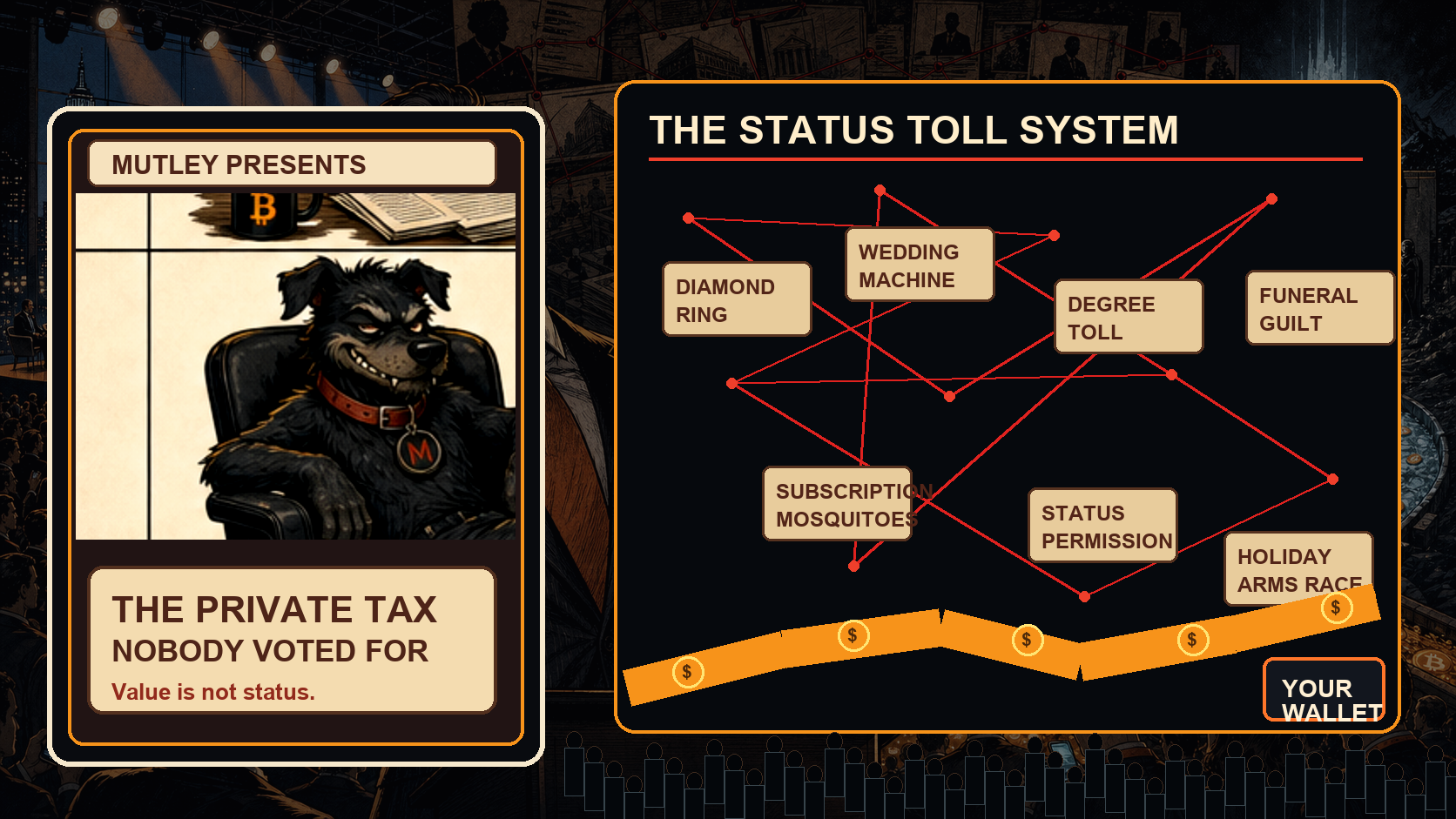
The government is not the only tax collector in town.
The IRS is the honest gangster. It tells you the number, threatens you in writing, gives you a deadline, and expects payment by April.
Crude, yes.
But at least the knife is visible.
The private tax is slicker.
The private tax does not always arrive as a law. It arrives as expectation.
Tradition.
Romance.
Respectability.
Professionalism.
Security.
Belonging.
“That's just what people do.”
“You don’t want to look cheap.”
“You need the credential.”
“You only get married once.”
“What will people think?”
Ah, there it is.
The most expensive sentence in American life.
What will people think?
That sentence has financed more garbage than Congress, which is impressive, because Congress spends like a drunk pirate with a lobbyist whispering in one ear and a reelection committee holding the other hand.
But private industry found something better than taxation.
It found shame.
And shame is magnificent for business.
You do not need a federal agency when you can get families, coworkers, classmates, neighbors, social media, HR departments, wedding vendors, guidance counselors, funeral homes, luxury brands, subscription platforms, and insecure parents to enforce the payment schedule for you.
Government taxes you by law.
Private industry taxes you through fear.
Fear of looking poor.
Fear of looking unserious.
Fear of being judged.
Fear of disappointing people.
Fear of being left behind.
Fear of not being a real adult.
Fear of not loving enough, grieving enough, parenting enough, earning enough, celebrating enough, signaling enough.
It is brilliant, in the way a tapeworm is brilliant.
Hide inside a real human need, then start billing.
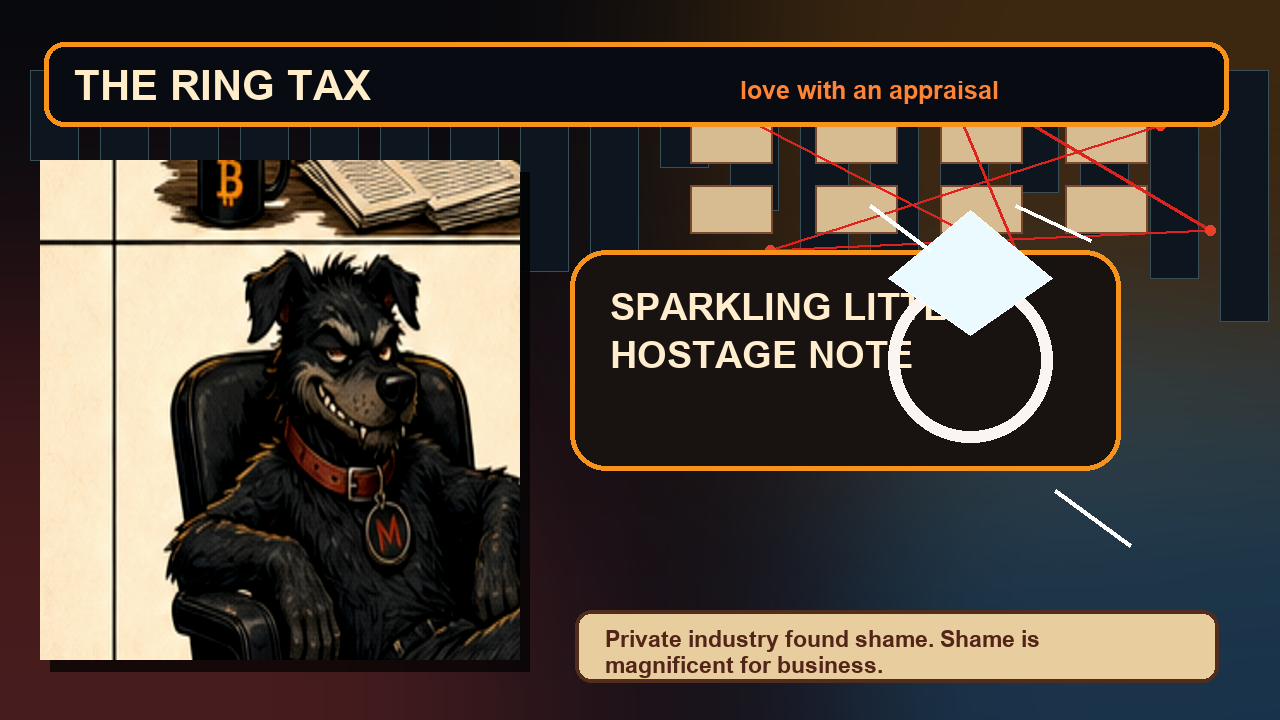
Start with the diamond ring.
Some poor kid falls in love, catches a dangerous little disease known as optimism, and before he can even ask another human being to build a life with him, society tells him he needs to buy a shiny rock with a marketing department.
What does the diamond do?
Does it cook?
Does it fix the roof?
Does it lower the rent?
Does it make either person more loyal, more honest, more patient, more capable, less likely to become a courtroom exhibit over dishwasher loading theory?
No.
It sits there.
Sparkling little hostage note.
And if the rock is not big enough, suddenly the question is no longer, “Do these two people love each other?”
Now the question is, “What does the ring say?”
What does it say?
It says somebody sold insecurity wholesale and called it forever.
Now, before the romance police start barking, relax. Nobody is saying beauty has no value. Nobody is saying gifts are bad. Nobody is saying a ring cannot mean something if two people decide it means something.
The scam is not the object.
The scam is the coercion around the object.
The scam is the social machine that takes a private promise and turns it into a public invoice.
Then comes the engagement party.
Because apparently agreeing to maybe have a wedding now requires a pre-wedding celebration for the upcoming wedding celebration.
We used to call that bloat.
Now we call it an event.
Then the wedding itself.
Flowers. Hall. Photographer. Videographer. Dress. DJ. Favors nobody keeps. Centerpieces nobody asked for. Open bar diplomacy. Seating charts designed by Satan. A cake priced like it went to medical school.
And every vendor knows the magic word.
Wedding.
Say “party” and it costs one thing.
Say “wedding” and the invoice puts on a tuxedo and starts bench-pressing your savings.
Again, the scam is not celebration.
A good wedding can be beautiful. Families gather. People dance. Old grudges take one night off. Somebody’s uncle gets sentimental near the shrimp tray. Fine. That is human. That is memory.
But the industrial version is different.
The industrial version says the size of the party proves the size of the love.
The industrial version says if you do not spend enough, you did not care enough.
The industrial version whispers, “You only get one day,” while quietly hoping you finance it over five years.
That is not romance.
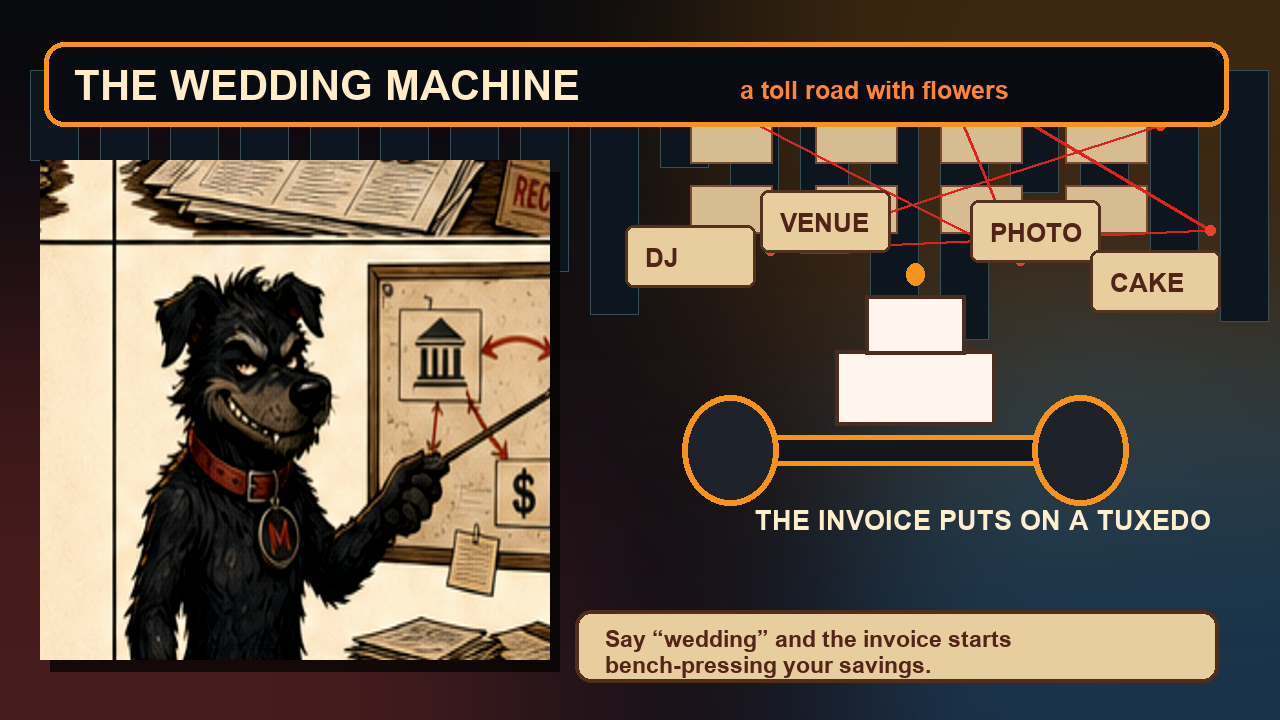
That is a toll road with flowers.
And this is the structure of the private tax.
First, an industry finds a normal human need.
Love.
Grief.
Status.
Security.
Education.
Parenting.
Health.
Career survival.
Belonging.
Then it attaches a toll booth to that need.
Then it teaches society to shame anyone who walks around the toll booth.
That is the whole game.
Not “buy this because it is useful.”
No, no. Much better.
Buy this or look poor.
Buy this or look cheap.
Buy this or look like a bad husband.
Buy this or look like a bad mother.
Buy this or look like you do not respect the dead.
Buy this or your kid will fall behind.
Buy this or nobody will hire you.
Buy this or your house will look embarrassing.
Buy this or you are not a real adult.
The product becomes a receipt for social permission.
That is not a market.
That is a church collection basket with better lighting.
College did this beautifully.
A whole generation was told the same story.
Go to college. Get the certificate. Take the debt. Then you can get a respectable job working for somebody who will call you “family” right before layoffs.
Now, do some degrees matter?
Of course.
Doctors. Engineers. Nurses. Accountants. Skilled technical fields. Real licensing. Real knowledge. Real consequences.
Nobody wants a surgeon who learned anatomy from vibes and a comment section.
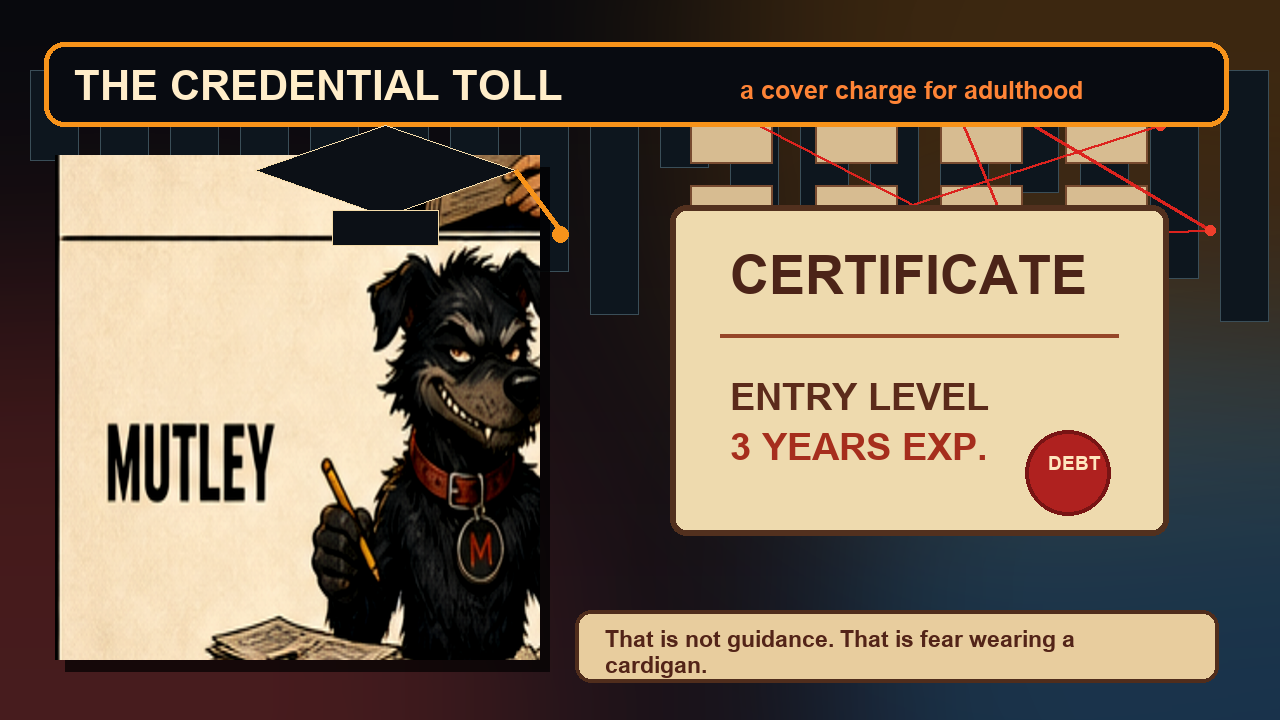
But a giant piece of the credential machine stopped being education and became a cover charge for adulthood.
Jobs that used to require competence started requiring a diploma because the HR machine needed a filter and colleges needed customers.
So the kid pays.
Tuition. Fees. Books. Housing. Meal plan. Parking. Interest. Four years of opportunity cost.
Then the diploma hits the desk and the job listing says entry level, three years experience.
Beautiful.
A toll road to a cubicle.
And if the kid questions it, the adults panic.
“What else are you going to do?”
That is not guidance.
That is fear wearing a cardigan.
The same machine shows up in parenting.
A child used to have a birthday.
Now some of these birthdays look like product launches for a tiny dictator.
Theme. Balloons. Bounce house. Dessert table. Professional photos. Matching shirts. Custom favors. A sign with the child’s name in cursive big enough to be seen from space.
The child is four.
He wants cake and the box the gift came in.
But the parents are not only throwing the party for the child.
They are throwing it for the invisible courtroom of other parents.
Same with youth sports.
Travel team. Private coach. Tournament fees. Hotels. Gear. Training. Highlight videos. Specialized camps. A family minivan converted into a minor league logistics department.
Is some of it good? Sure.
Discipline, teamwork, confidence, effort — lovely.
But once the status arms race starts, every parent is afraid to be the one who does less.
And industry loves an anxious parent.
An anxious parent is a wallet with a heartbeat.
Then there is the grief tax.
This one is especially charming, if by charming we mean morally feral.
A family loses somebody. Their brain is fogged. Their heart is cracked. Nobody is thinking clearly. And in that moment, an entire pricing universe appears.
Casket. Service. Flowers. Plot. Stone. Transportation. Obituary. Viewing. Packages.
And underneath it all, the ugliest possible whisper:
You loved them, didn’t you?
Well then.
Prove it.
That is the private tax at its most obscene. It knows exactly when you are least able to fight back.
Again, honoring the dead is not the scam.
Ritual matters. Memory matters. Saying goodbye matters.
The scam is converting grief into a menu of guilt upgrades.
Then comes the professional tax.
The wardrobe. The commute. The phone. The laptop. The software. The subscriptions. The certifications. The networking drinks. The personality polish. The LinkedIn theater. The unpaid extra effort required to be perceived as committed.
You are not just doing the job.
You are financing the costume of employability.
Then the company says, “We are like a family.”
No, you are not.
Families do not usually make you upload your resume into a portal and then ask you to manually type the same information into forty-seven boxes like a lab rat with rent due.
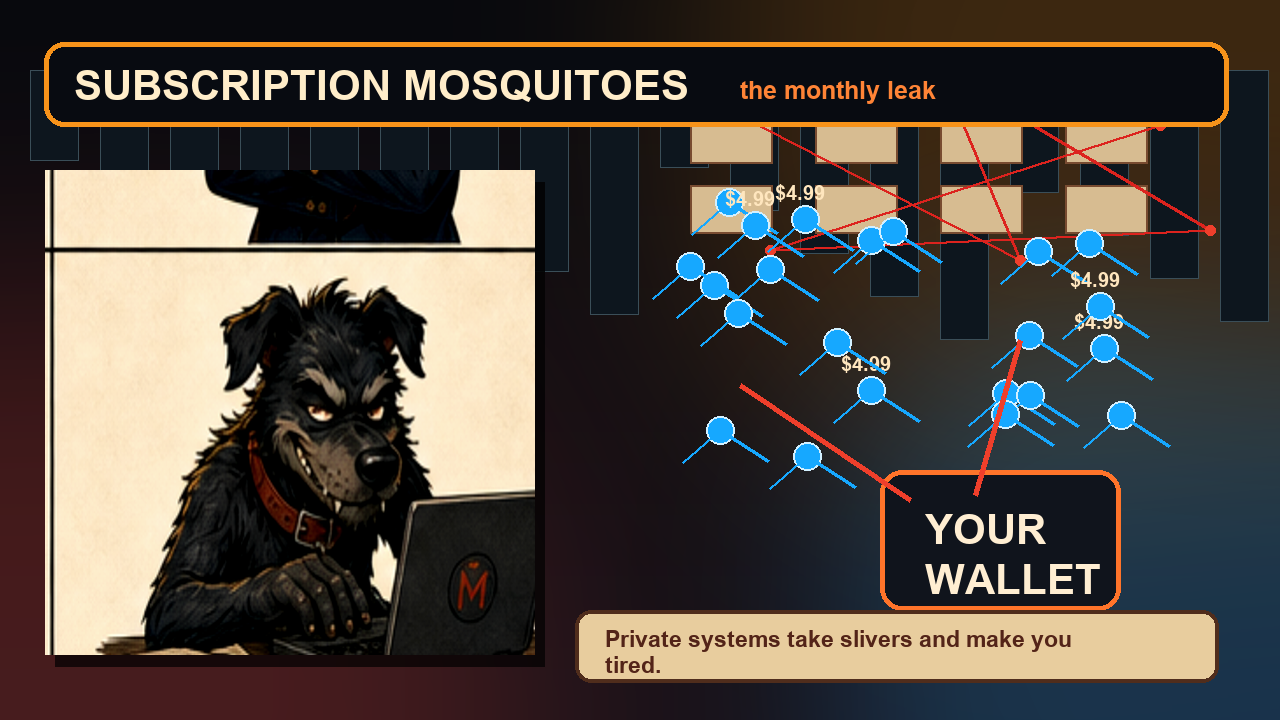
And while all of that is happening, subscriptions nibble the corpse.
Five dollars here. Twelve there. Streaming, cloud storage, productivity apps, memberships, platform fees, convenience fees, service fees, processing fees, “because we can” fees.
The modern economy looked at mosquitoes and said, yes, but make them monthly.
It is not one giant bite.
It is a swarm.
And every company wants to be your default leak.
Not your purchase.
Your leak.
A little money escaping forever while you are too busy to notice.
That is the genius of it.
Government takes a chunk and makes you angry.
Private systems take slivers and make you tired.
And tired people do not audit.
They just keep paying.
Now add the holiday tax.
Valentine’s Day. Mother’s Day. Father’s Day. Back-to-school. Halloween. Thanksgiving. Christmas. New Year. Graduation. Prom. Baby shower. Bridal shower. Gender reveal. Retirement party. Housewarming. Every human milestone gets dragged through the retail machine until affection needs a receipt.
Again, celebration is not the enemy.
The enemy is the upgrade path.
The enemy is when love becomes performance and performance becomes debt.
Diamonds say love.
Weddings say legitimacy.
Degrees say worth.
Funerals say respect.
Luxury brands say status.
Children’s activities say good parenting.
Corporate credentials say professionalism.
Subscriptions say convenience.
Tipping screens say guilt.
Holiday spending says family.
And some of those things can be meaningful.
That is what makes the scam durable.
A meaningless scam dies fast.
A scam attached to a real emotion gets to wear human skin.
That is the part people miss.
The private tax does not work because everyone is stupid.
It works because everyone is human.
People want to be loved.
They want to be respected.
They want their children to be okay.
They want their parents to be proud.
They want their dead honored.
They want their spouse to feel chosen.
They want their home to feel safe.
They want to belong.
Those are not weaknesses.
Those are the best parts of people.
And industry walks right up to those best parts, puts a little toll booth in front of them, and says, “Lovely feelings you have there. Be a shame if anyone thought they were insufficient.”
That is the private tax.
The government taxes your income.
The Federal Reserve taxes your savings by making the money weaker.
Private industry taxes your fear of not belonging.
That third one might be the nastiest because people enforce it on each other for free.
Nobody from the diamond lobby has to show up at Thanksgiving and call you cheap.
Aunt Somebody will do it with a casserole spoon in her hand.
Nobody from the wedding industry has to threaten the relationship.
Instagram will handle the comparison while everyone pretends it is inspiration.
Nobody from the college-industrial complex has to personally shame your kid.
Every guidance counselor, job portal, HR filter, credential drunk parent, and frightened relative will explain that the degree is the only safe path, even while graduates are drowning in debt and working jobs that treat them like replaceable furniture.
A tax needs enforcement.
Government uses law.
Private industry uses status.
And status is cheaper because the victims help collect it.
That is why this machine is so hard to fight.
Because if you refuse a government tax, eventually some agency appears.
If you refuse a private tax, your own circle may do the collecting.
They will not call it collecting.
They will call it concern.
They will say they just want what is best.
They will say they do not want you to regret it.
They will say people will talk.
They will say your child deserves it.
They will say your fiancé deserves it.
They will say your mother would have wanted it.
They will say this is how the world works.
And sometimes they are not lying.
That is the irritating part.
Sometimes the world really does work that way.
Sometimes the credential opens the door.
Sometimes the suit changes the room.
Sometimes the ceremony matters.
Sometimes the gift lands.
Sometimes the tradition carries memory.
So no, the answer is not to become some joyless cave creature who refuses every ritual, buys nothing, celebrates nothing, and gives children socks for Christmas because “Mutley said capitalism is a flea circus.”
Do not be that guy.
Nobody likes that guy.
That guy brings a spreadsheet to a birthday party and wonders why the dog hates him.
The answer is not to reject meaning.
The answer is to stop confusing price with meaning.
That is the line.
A real tradition binds people together.
A fake tradition makes people anxious about whether they paid enough.
A real celebration creates memory.
A fake celebration creates content.
A real credential proves preparation.
A fake credential rents social permission.
A real gift says, “I know you.”
A fake gift says, “I hope this satisfies the audience.”
A real funeral honors a life.
A fake funeral package monetizes panic.
That is how you tell the difference.
Ask what the thing actually does.
Ask who profits from your embarrassment.
Ask whether the ritual makes people closer, stronger, wiser, more grateful, more rooted.
Or whether it makes everyone anxious, broke, performative, resentful, and weirdly afraid of photos.
If it is the second one, congratulations.
You found a private tax.
And no, you will not beat all of them.
You live in the world. You have family. You have work. You have obligations. You cannot spend your whole life being the lone philosopher at the buffet muttering about incentive structures while everyone else eats shrimp.
Pick your fights.
But pick some.
Buy the ring if it means something.
But do not buy the ring because an industry taught everyone that love needs a retail appraisal.
Have the wedding if it builds a memory.
But do not let the wedding eat the marriage before the marriage starts.
Go to college if the degree leads somewhere real.
But do not worship the certificate like a magic ticket while the debt meter grins in the corner.
Honor your dead.
But do not let grief salesmen turn respect into a financing plan.
Celebrate your kids.
But do not turn childhood into a branded arms race because every parent is terrified of being judged by other terrified parents.
Keep the rituals that carry meaning.
Starve the rituals that only carry invoices.
The government will keep taxing you.
The money printer will keep watering the soup.
The official thieves will keep wearing flag pins and pretending the fire is weather.
But the private taxes?
Some of those you can fight.
Not all at once.
Not perfectly.
Not without people giving you the look.
Fight them anyway.
Because every time you refuse to buy permission, the machine loses a little oxygen.
Every time you choose meaning over performance, the toll booth gets a little lonelier.
Every time you ask, “What does this actually do?” you become harder to farm.
And that is what they hate.
A person who can tell the difference between value and status is much harder to invoice.
Final bite:
The worst tax is not always the one written into law.
Sometimes it is the one society scares you into paying while pretending you volunteered.
— Mutley