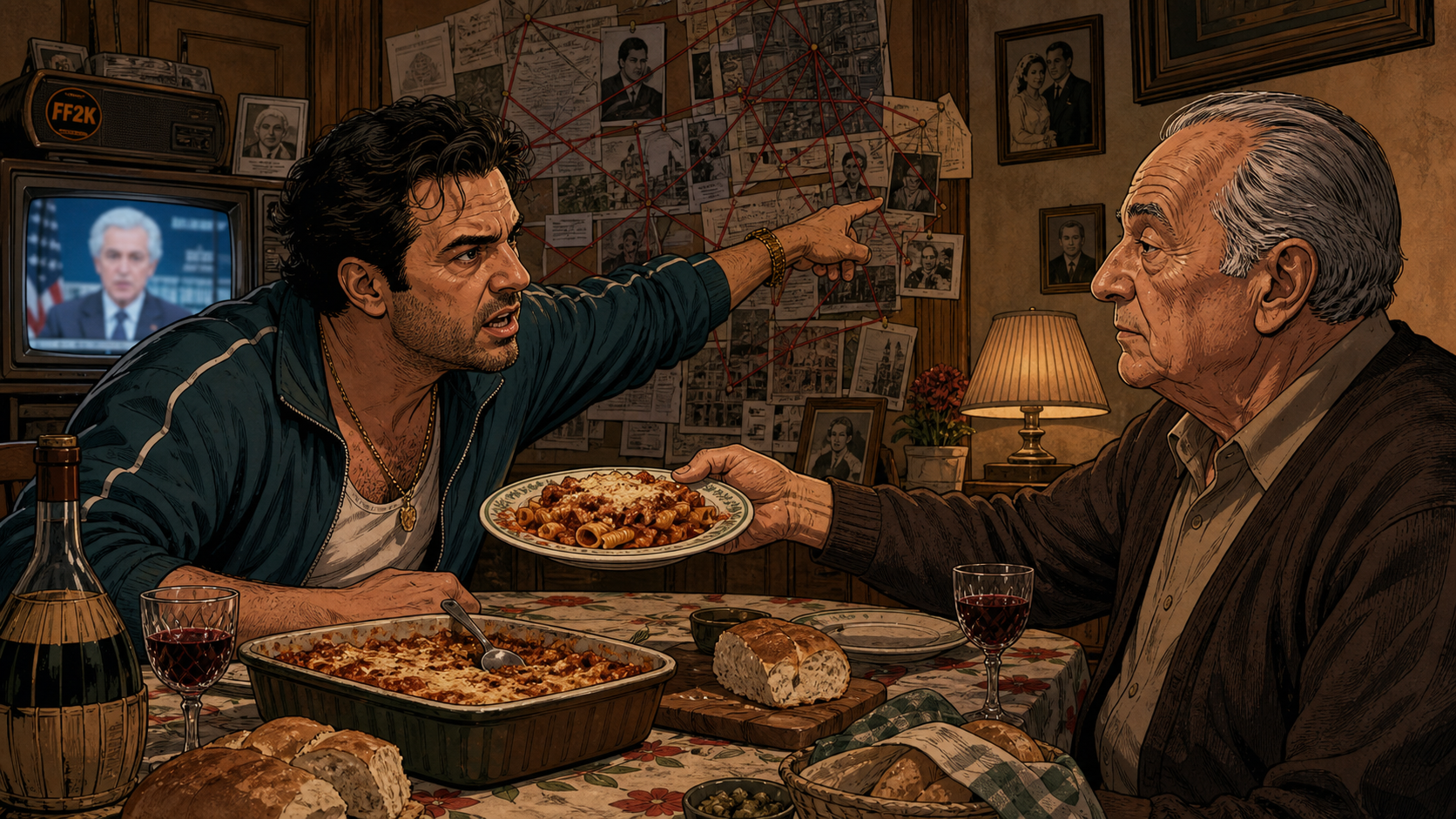
Danny Militello first suspected America had been conquered on a Sunday afternoon in Staten Island, between the baked ziti and the cannoli.
His Uncle Sal—seventy-eight years old, two heart attacks, one functioning knee, and a lifelong distrust of anybody who wore a tie before noon—had announced that he was getting the shot.
Danny lowered his fork.
“You don’t even take the pills Dr. Kaplan gives you.”
“Kaplan’s a thief.”
“But this guy you trust?”
Sal pointed at the television with a sausage.
On the screen stood Dr. Enzo Facelli: five-foot-seven, silver-haired, sharp-eyed, speaking from behind a government podium as if he had personally caught the virus breaking into his garage.
“Look at him,” Sal said. “He’s Italian.”
Danny waited for the rest of the argument.
There was no rest of the argument.
Aunt Marie nodded solemnly. “And he don’t look scared.”
That was the moment the whole thing clicked.
Not the vaccine. Not the virus. Not the endless arrows, charts, mandates, experts, counterexperts, and cable-news doctors who all looked like they had been assembled in the same laboratory.
The Italians.
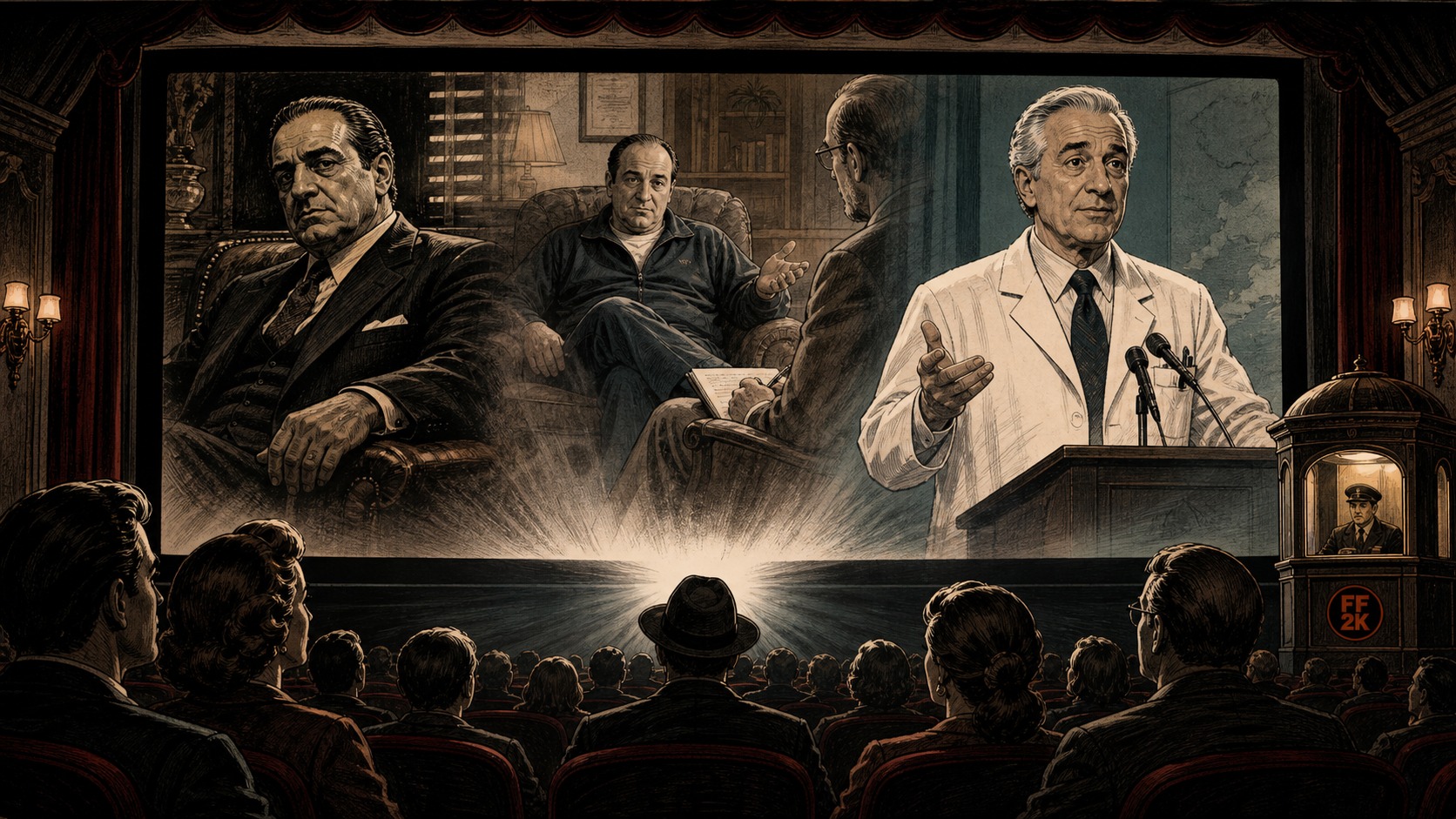
For fifty years, Hollywood had taught America one sacred truth: the Italian-American male could not be frightened.
First came The Godfather. Italians were ancient, composed, and deadly. They did not panic. They sat in dark rooms and made other people panic.
Then came The Sopranos. Now they had anxiety, cholesterol, suburban mortgages, and mothers who weaponized guilt—but they were still dangerous. Even their panic attacks had swagger.
And then, precisely when the nation was most afraid, the government produced Dr. Enzo Facelli.
No dark office. No tracksuit. No cigar.
Just a lab coat.
Danny stared at the television while Facelli calmly explained that the new treatment was safe, effective, and everybody’s civic responsibility.
Sal grunted approvingly. “He talks straight.”
Danny looked around the table.
These were people who believed the moon landing had suspicious lighting. People who assumed every mechanic was lying, every politician was stealing, and every restaurant charging more than eighteen dollars for veal was laundering money.
Yet Facelli had passed through their defenses without resistance.
Because somewhere beneath language, beneath reason, beneath conscious thought, America heard the same message:
If the Italian guy ain’t scared, what the hell are you scared of?
Danny put down his fork.
“Oh my God.”
His wife, Nicole, didn’t look up. “What now?”
“The Godfather was phase one.”
The table went quiet.
Nicole closed her eyes. “Please don’t start a podcast.”
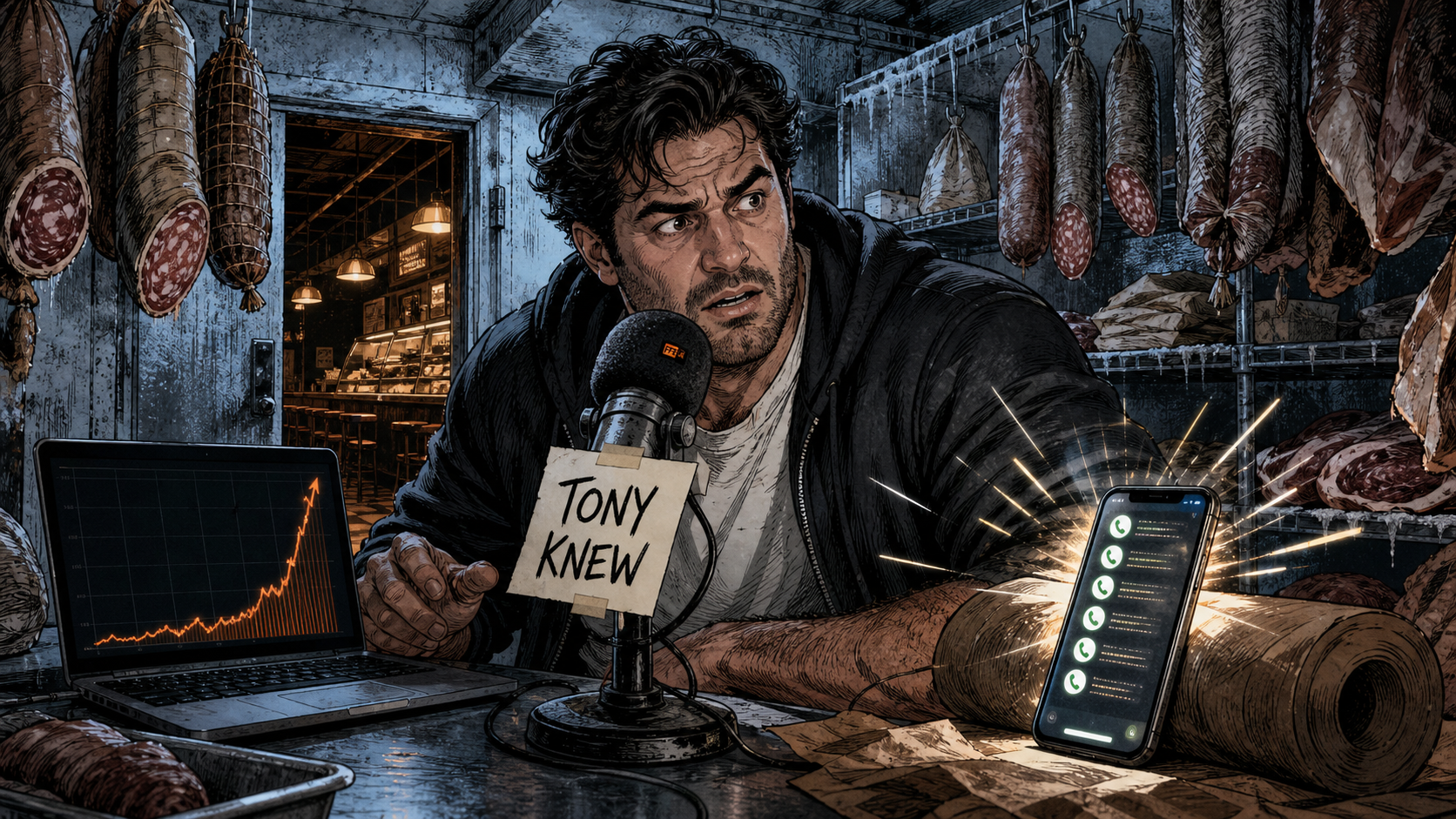
He started the podcast Tuesday.
He called it TONY KNEW.
The first episode—Leave the Gun, Take the Booster—was recorded inside the walk-in freezer of Militello’s Fine Meats because it was the only place Nicole couldn’t hear him.
Danny laid out the theory carefully.
Hollywood had spent decades constructing the Italian as America’s supreme masculine authority: loyal, skeptical, unbreakable. Then public-health officials borrowed that authority and transferred it, subconsciously, onto Facelli.
It was not medical persuasion.
It was cultural ventriloquism.
The episode received thirty-seven plays.
Twenty-nine were Danny checking the analytics.
The thirtieth listener sent him a document.
It was a badly scanned academic paper from 1986 titled:
ETHNIC MASCULINITY AS A CREDIBILITY-TRANSFER VECTOR DURING PERIODS OF NATIONAL INSTABILITY
The author was listed as Dr. Murray Z. Bloom, Office of Strategic Communications.
Danny read the title three times.
Then he called Uncle Sal.
“I found the blueprint.”
Sal sighed. “Did you find somebody to fix my printer?”
“This is bigger than your printer.”
“Nothing is bigger than my printer. It says it’s offline. It’s right there.”
But Danny was no longer listening.
At the bottom of the paper, beneath a coffee stain shaped vaguely like Sicily, someone had handwritten five words:
FINAL PHASE REQUIRES A DOCTOR.
Danny felt the room tilt.
For the first time, his theory was no longer merely ridiculous.
It was ridiculous with a footnote.
Danny spent the next forty-eight hours searching for Dr. Murray Z. Bloom.
He found six.
One was a pediatric dentist in Queens.
One had died in 1974.
One sold competitive parakeets in Paramus.
The fourth lived in Boca Raton and had written three books: Strategic Persuasion in the Television Age, The Republic of Symbols, and Pickleball After Sixty: Stop Apologizing for the Lob.
Danny booked a flight.
Nicole watched him pack three black shirts, two pairs of black pants, and a black leather jacket.
“You’re going to Florida,” she said. “Not a funeral.”
“You dress for the mission.”
“You sell sandwiches.”
“I employ seven people.”
“Four of them are cousins.”
“That’s called a trusted network.”
She stared at him for a long moment.
“If you get arrested trying to interrogate an old man, I’m not calling your brother.”
“My brother’s useless.”
“That’s why I’m not calling him.”
Century Village was surrounded by a gate, a guardhouse, and the most aggressive bougainvillea Danny had ever seen.
He told the guard he was delivering gabagool.
The guard was from Ohio.
This simplified matters considerably.
Ten minutes later Danny found Murray Bloom on Pickleball Court Three, wearing wraparound sunglasses, orthopedic sneakers, and a shirt that read:
DINK RESPONSIBLY
Bloom was ninety-one and moved with the serene economy of a man who had outlived all his enemies and several long-term warranties.
Danny waited until the game ended.
“Dr. Bloom?”
Bloom studied him.
“You selling solar?”
“No.”
“Medicare Advantage?”
“No.”
“Then why are you dressed like a widower?”
Danny held up the paper.
The old man’s face changed.
Not dramatically. There was no cinematic gasp, no trembling hand, no whispered Where did you get that?
He merely stopped smiling.
“That,” Bloom said, “was never supposed to leave the department.”
Danny’s heartbeat became audible.
“So it’s real.”
“Of course it’s real. You think the government only writes smart things?”
Bloom picked up his water bottle and walked toward a shaded bench. Danny followed.
“What was the final phase?”
“I don’t remember.”
“It says it required a doctor.”
“At my age, everything requires a doctor.”
“Dr. Enzo Facelli.”
Bloom sat down.
“Who?”
Danny searched his face for deception. All he found was sun damage.
“The public-health guy. Pandemic. Television. Little Italian guy.”
“Oh. Him.” Bloom shrugged. “Seemed competent.”
“You designed him.”
Bloom laughed so violently that a woman on Court Two missed her serve.
“Son, in 1986 I couldn’t get the department to approve a new photocopier.”
Danny placed the paper on the bench between them.
“You wrote that Italian masculinity could be transferred into institutional trust.”
“No. I wrote that ethnic archetypes could be used as credibility shortcuts.”
“What’s the difference?”
“About twelve pages and tenure.”
Bloom tapped the title.
“It was theory. Americans don’t trust institutions. They trust characters. The cowboy. The priest. The tough cop. The kindly grandmother. The no-nonsense doctor. You dress authority in a familiar costume and people stop examining the authority.”
“And the Italian tough guy?”
“A very effective costume.”
Danny felt a surge of vindication.
“So I’m right.”
“I didn’t say that.”
“You just described the whole operation.”
“I described advertising.”
“You wrote ‘final phase requires a doctor.’”
Bloom squinted at the handwriting.
“That isn’t mine.”
Danny’s certainty flickered.
“Whose is it?”
Bloom removed his sunglasses.
“I haven’t seen that handwriting in forty years.”
For the first time, the old man appeared frightened.
Not terrified. Not movie frightened. Bureaucrat frightened—the particular dread of a man who had just remembered a meeting he had spent decades pretending never happened.
Bloom looked around the courts.
“Walk with me.”
They passed artificial lakes, identical condominiums, and several elderly men driving golf carts with the concentrated hostility of fighter pilots.
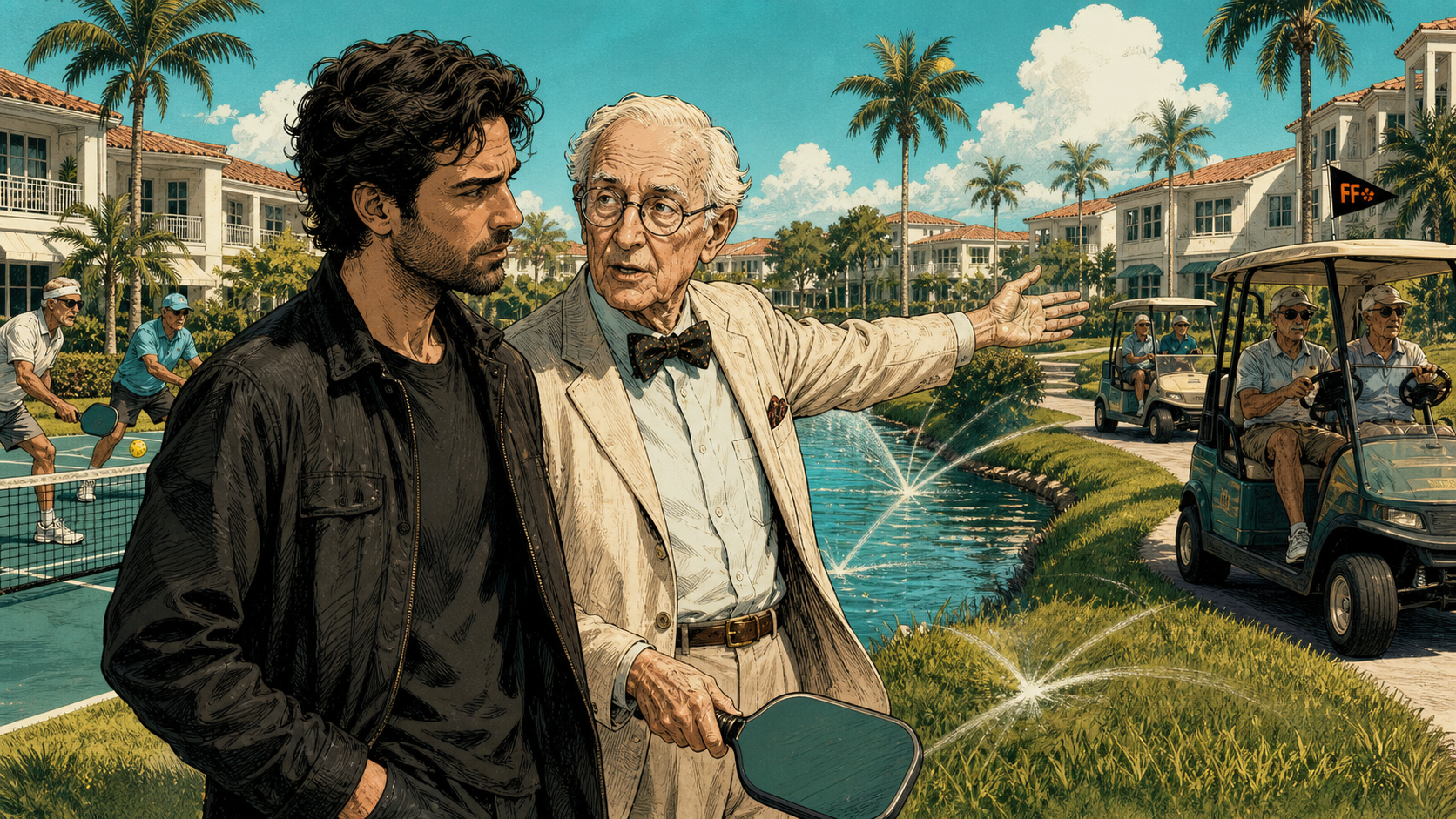
“In 1987,” Bloom said, “a private contractor took interest in our work. Meridian Strategic Systems.”
“Defense?”
“Everything was defense back then. Soda commercials were defense. Sitcoms were defense. If a cartoon squirrel made Communism look stupid, somebody at the Pentagon filed an expense report.”
“What did Meridian want?”
“To industrialize trust.”
Bloom spoke more quietly now.
“They believed persuasion was too focused on arguments. Arguments can be resisted. Identity is harder. Their idea was to build cultural figures decades in advance, then activate the emotional associations later.”
Danny stopped walking.
“Like sleeper agents.”
“Not people. Archetypes.”
“The Italian tough guy.”
“That was one model.”
“What were the others?”
Bloom glanced at him.
“The humble billionaire. The rebellious corporation. The anti-establishment politician. The celebrity scientist. The comedian who tells you what news is real.”
Danny’s mouth went dry.
“They built all of them?”
“Built? No. That’s the mistake conspiracy people always make. Nobody builds a river. You dig channels. The water does the rest.”
They reached Bloom’s condominium.
He unlocked the door but did not enter.
“Meridian asked us to identify the strongest trust archetype in America. We concluded it wasn’t the president, the soldier, or the preacher.”
“Who was it?”
“The reformed sinner.”
Danny frowned.
Bloom continued.
“Americans distrust purity. They trust the man who has seen the darkness and chosen to warn them. The ex-gangster. The former addict. The retired spy. The whistleblower.”
Danny felt something cold move through him.
His podcast downloads had climbed from thirty-seven to twelve thousand during the flight.
He had received interview requests from three national shows.
Someone had already made shirts.
Bloom looked at him with something almost like pity.
“You thought you discovered the operation.”
Danny said nothing.
Bloom opened the door.
“Maybe the operation discovered you.”
Back at the hotel, Danny found seventeen missed calls.
Nicole.
Uncle Sal.
Two television producers.
A number from Washington.
And one blocked caller who had left a voicemail consisting of six seconds of silence followed by the unmistakable sound of a man chewing.
Danny listened to it four times.
Then someone knocked.
Three slow knocks.
Danny approached the door and looked through the peephole.
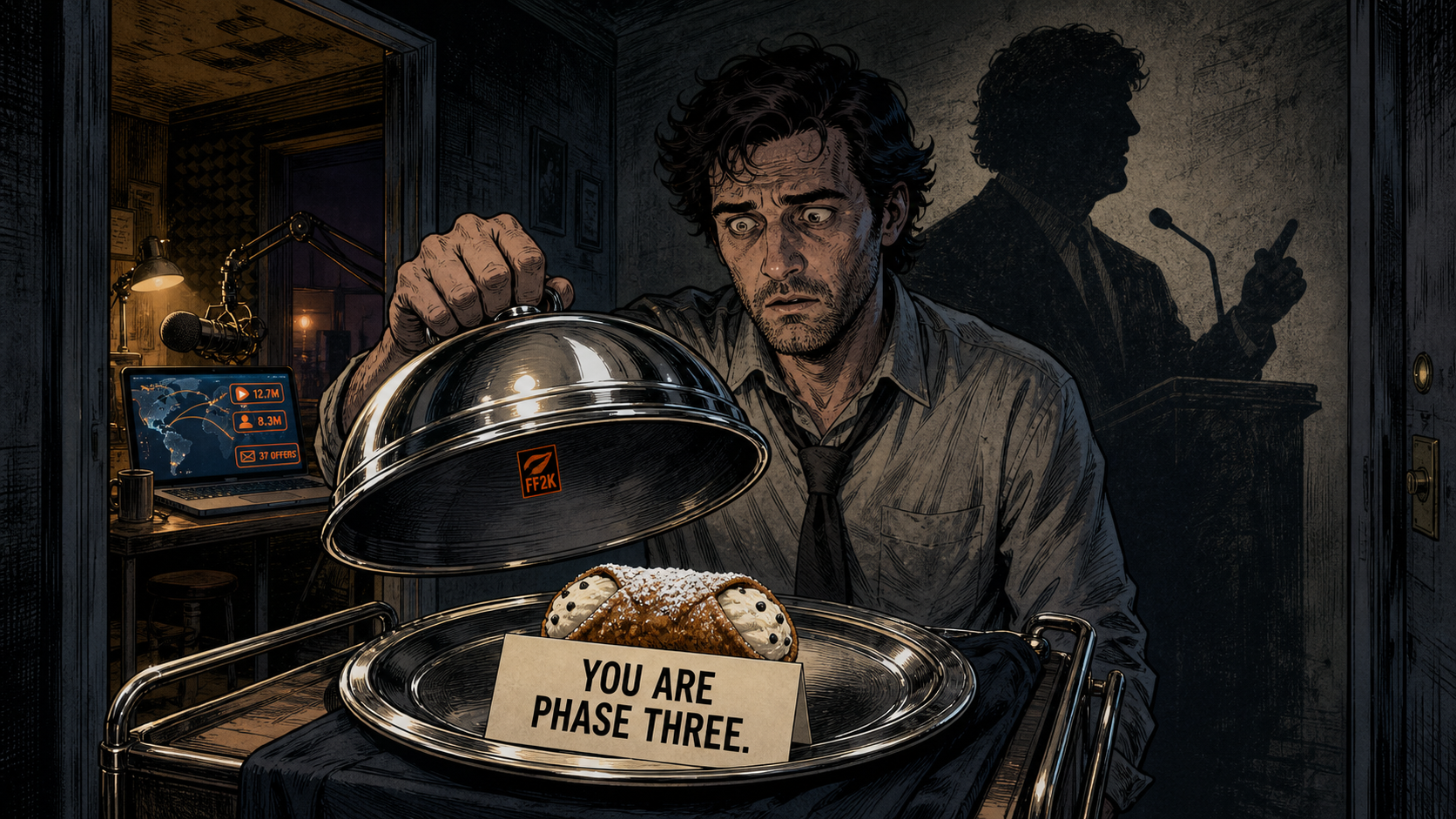
A room-service cart stood alone in the hallway.
On it sat a silver dome.
Beneath the dome was a plate containing one cannoli.
Beside it lay a handwritten note:
THE DOCTOR WAS NEVER PHASE THREE.
Danny turned the card over.
On the back:
YOU ARE.