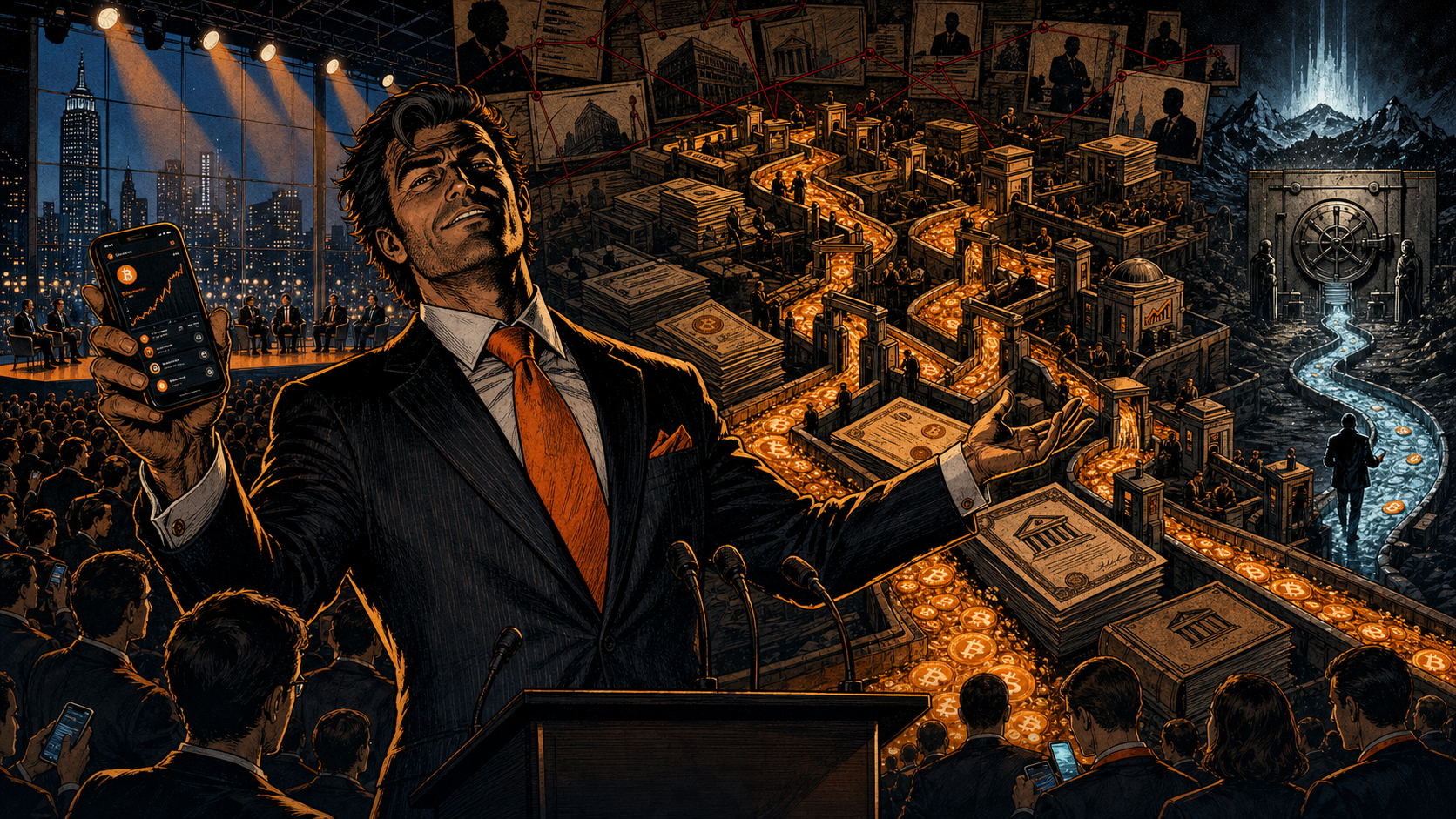
The meeting, in this story, happens in a glass tower somewhere between the forty-second and forty-fifth floor, where the air is recycled and the carpets are the color of old money.
It is not a formal meeting. It is more like a realization, the kind that spreads through a class of people the way a smell spreads through a room, without anyone saying the word out loud.
The realization is this: we are about to be disintermediated.
Not today. Not this quarter. But at some scale, somewhere between a trillion dollars and the full weight of human savings, the thing that Bitcoin threatens to do is remove them. The custodians. The settlement layers. The fee extractors. The issuers of instruments. The architects of yield. The whole cathedral of people whose livelihoods depend, structurally, on capital flowing through something rather than to something.
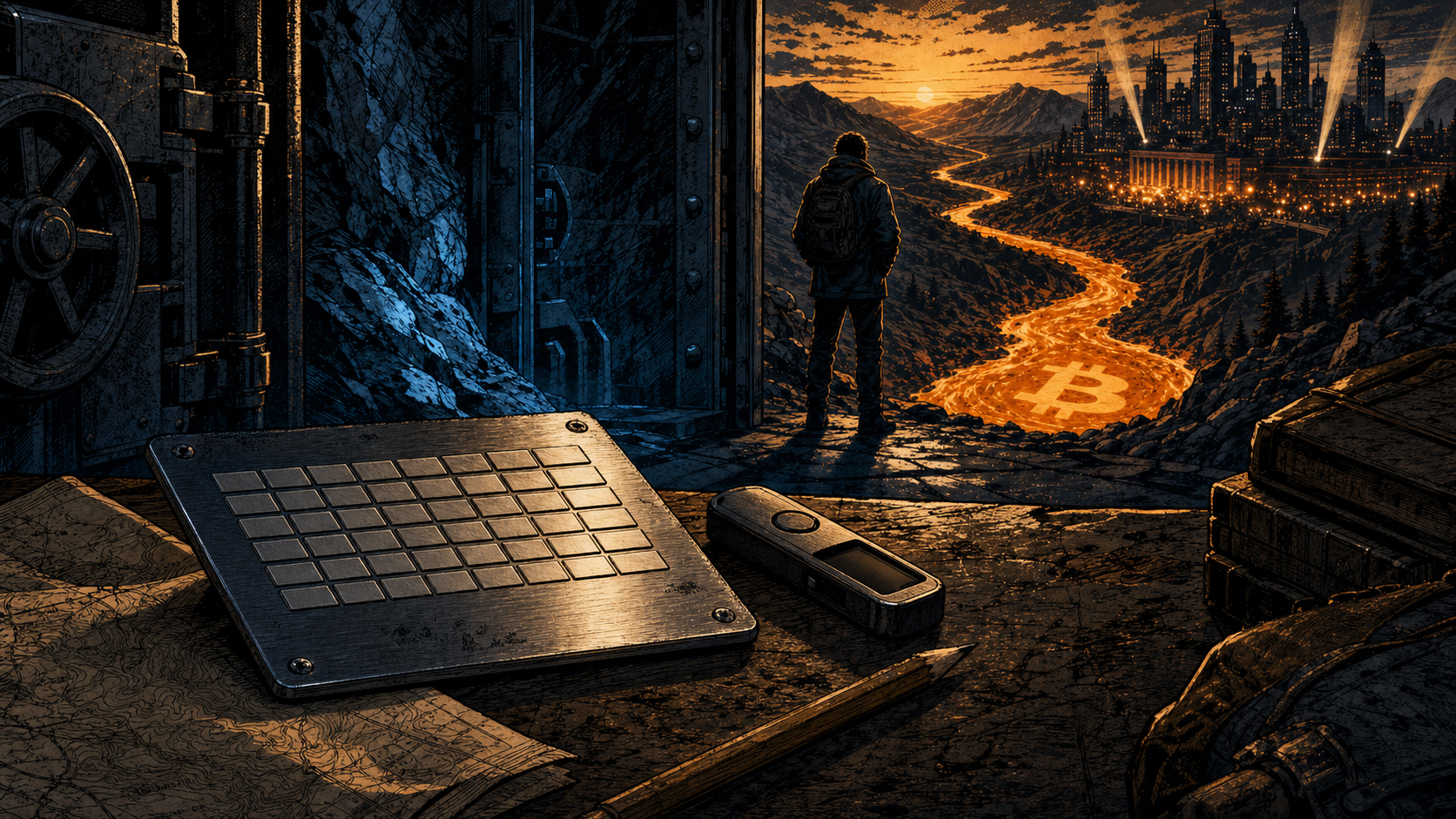
Bitcoin, held directly, held in a wallet, held by an individual with a seed phrase scratched on a steel plate and buried somewhere cold, pays no one. It employs no one. It generates no basis points, no management fee, no spread, no custody charge, no advisory wrap, no 12b-1 fee, no carried interest. It is, in the language of the forty-second floor, unmonetizable.
And it was getting very, very large.
The wrapper arrivesSo they did what clever people do when they cannot stop something: they packaged it.
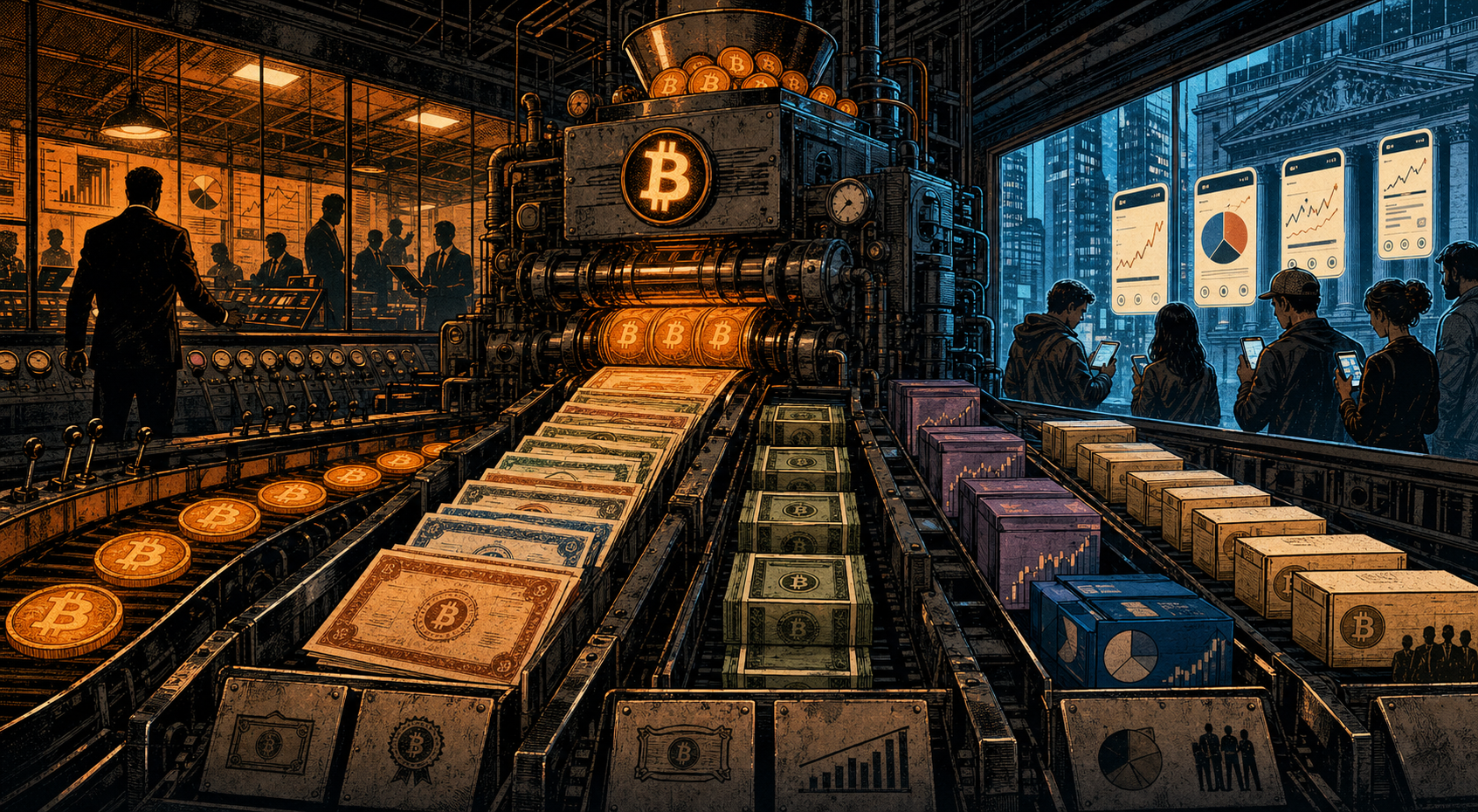
The packaging is beautiful, as all packaging is beautiful. It is designed to feel like the thing inside. Buy this product and you are in Bitcoin. You are exposed to Bitcoin. You are getting Bitcoin upside. You can buy it in your brokerage account, right next to your S&P 500 fund, without moving anything off-exchange, without learning what a UTXO is, without the terrifying step of becoming, even for a moment, your own bank.
The product is, in its purest form, a company. The company sells stock. It uses the money to buy Bitcoin. The stock trades at a premium to the Bitcoin underneath it, because the market is willing to pay extra for the convenience, for the story, for the theater of it.
And the theater is everything.
Enter the Carnival Barker.
He appears on stage in an orange tie, always the orange tie, a wink at the faithful that he is one of them, that he has crossed over, that he is not merely a financier in costume but a true believer who happens to have excellent relationships with prime brokers. The crowd at these conferences is young. Distressingly young. Bright-eyed and carrying notebooks and wearing lanyards and looking up at him the way people looked up at preachers in tents before television ruined the spectacle.
He speaks in aphorisms, in fictionalized parables.
Bitcoin is the hurdle rate of the universe.
Full stop.
Every other asset is just Bitcoin you have not bought yet.
The crowd writes this down. The crowd posts it. The crowd converts their colleagues, their parents, their Reddit communities.
And then, quietly, structurally, elegantly, the Carnival Barker issues more stock.
This is the genius of it. He does not sell his Bitcoin. He does not need to. He issues equity at a premium, which means he raises cash at a cost lower than the Bitcoin he buys with it, which means the value per share of Bitcoin goes up, which makes the premium expand, which allows him to issue more equity. It is a machine. It is a beautiful, self-referential machine that requires, for its continued operation, one thing above all others: new capital entering through Wall Street channels.
Not through a hardware wallet. Not through a peer-to-peer transaction. Through a brokerage account. Through an ATM machine. Through a licensed broker-dealer.
Through the system.
The machine employs analysts. It employs convertible note underwriters. It employs preferred equity structurers. It employs investor relations professionals and compliance officers and prime brokerage desks and people who spend their days calculating the volatility skew on synthetic Bitcoin exposure instruments. Every dollar that flows into the equity wrapper instead of directly into the underlying asset is a dollar that has passed through a toll booth, and the toll booth has toll collectors, and the toll collectors have mortgages and boats and children in private school, and all of this depends on capital not going direct.
The diversionHere is the sinister part, and it is important to say sinister softly, almost admiringly, the way you say it about a chess move you did not see coming until it was too late.
The Bitcoin faithful, the ones who chanted not your keys, not your coins, who built the whole moral architecture of self-custody, who said the entire point was to exit the system, many of them looked at the Carnival Barker and saw a missionary. They saw someone using the tools of Wall Street to bring capital into Bitcoin. They celebrated the premium. They shared the aphorisms. They bought the preferred shares.
What they were actually watching was a diversion.
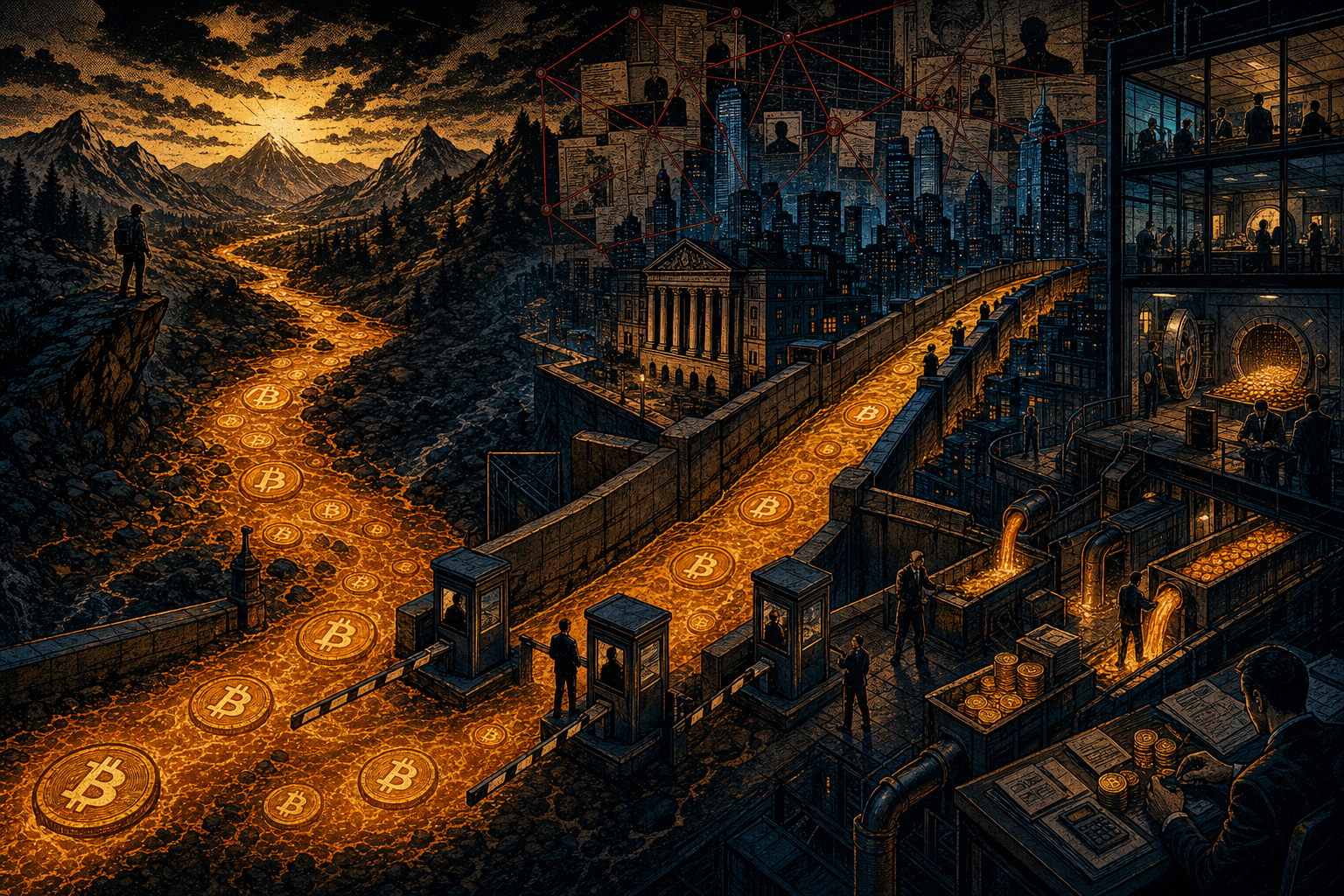
Imagine a river that was threatening to carve a new path through the landscape, one that would bypass the city entirely, drain the old canals, and leave the merchants who had grown fat on the waterway's passage with nothing but damp memories. The engineers of the city, clever, well-capitalized, generationally experienced at moving water through profitable channels, did not attempt to dam the river. That was impossible. The source was too strong.
What they did instead was dig a parallel channel, just upstream, that captured most of the flow before it could escape the city's control. The water still moved. The river still existed. But the city stayed wet, the merchants stayed fat, and the new path that would have changed everything was starved of the volume it needed to complete itself.
The parallel channel is the orange-ticker ecosystem.
The products multiply. There are exchange-traded funds that hold Bitcoin, which is good, actually, which is a genuine on-ramp, but which also means millions of people who feel they own Bitcoin do not own Bitcoin. They own a claim, administered by a custodian, settled through brokers, boxed inside rules most buyers will never read until the day they matter. There are treasury companies that buy Bitcoin with debt, leveraging fiat credit markets to accumulate an asset that was designed to exist outside fiat credit markets. There are preferred equity tranches that pay a yield, denominated in dollars, on Bitcoin exposure, which is almost a philosophical joke: you came here to escape the yield-bearing fiat system and you have been sold yield-bearing fiat instruments on top of Bitcoin.
Each layer adds a specialist. Each specialist adds a fee. Each fee adds a dependency on the continuation of the fiat system. The people who structure these instruments are not Bitcoiners. They are financiers who have found the most exciting product of their careers, and they will structure it until it stops being exciting, and then they will move on, and the structure will remain, and the structure will be administered, and the administration will cost something, and the cost will come from somewhere, and the somewhere is you.
On the forty-second floor, in the glass tower, the realization that spread like a smell through a room has, by now, fully settled. The feeling is not panic. It is not even concern. It is closer to relief.
They did not need to stop Bitcoin. They never needed to stop Bitcoin. They only needed to stop Bitcoin from escaping the system before the system could figure out how to tax it for passage.
The Carnival Barker takes a bow. The crowd cheers. The orange ties flutter in the conference center air conditioning. Outside, on the street, a person who has never heard any of this is trying to figure out how to withdraw their retirement savings from a platform that is having technical difficulties.
The questionThe Bitcoin beneath all the wrappers sits inert, uncomplaining, twenty-one million units waiting with the patience of mathematics. It does not know it has been packaged. It does not know it is being used as collateral. It does not know that a generation of young people believe they own it when they own something else entirely.
The seed phrase exists.
Someone should write it down.
This is a story about a mechanism, not a verdict. The Carnival Barker in this story is not a villain in the mustache-twirling sense. He is a man who found a gap between what the crowd wanted and what the system would allow, and he filled that gap with extraordinary skill and extraordinary returns and extraordinary oratory. Whether the gap he filled was a bridge or a trap depends on what happens next, and what happens next depends on whether the people buying the wrappers ever ask the question that the wrapper is specifically designed to make feel unnecessary:
Do I actually own any Bitcoin?
The capital diversion works as long as the question goes unasked. It works as long as the orange tie is more legible than the seed phrase, as long as the conference stage is more comfortable than the responsibility of custody, as long as exposure feels the same as ownership.
The river is still flowing.
The question is which channel it ends up in.
The names in this piece are archetypes. The mechanism is the story.