
I started in Detroit, watching a video about the Renaissance Center, that glass fortress on the river that went from civic promise to demolition math.
But Detroit is not the whole story.
The real story is Miami and New York, where the modern American skyline has started to look less like urban planning and more like a financing deck with windows.
Hudson Yards. Trump-branded towers. Porsche Design Tower. Aston Martin Residences. Billionaire pencil towers. Branded condos. Glass monuments sold as destiny before anyone answers the boring questions: who maintains it, who pays when the forecast misses, and what happens when the cheap-money era leaves town?
Not whether the buildings are beautiful. Some are. Not whether rich people should buy apartments with car elevators and sky pools. Fine. If a man wants to drive his Porsche into his living room, that is between him, the valet, and God.
The problem is the incentive structure underneath it.
And underneath that, sometimes literally, is the engineering.
These buildings are not leaning, sinking, leaking, stalling, or cracking because gravity got confused. They are doing it because the money was never as solid as the concrete pretended to be. The capital got abstracted. Layered. Leveraged. Licensed. Subsidized. Sold forward. Everyone found a way to move the risk one step away from themselves.
But the building cannot move the risk.
It has to sit on the soil. It has to meet the wind. It has to keep water out. It has to run elevators. It has to carry its own dead weight long after the spreadsheet guys have left the room.
Developers get rewarded for launching the project. Politicians for approving it. Banks for financing it. Branding partners for bolting glamour onto concrete. Consultants for making the future look inevitable.
Everybody gets paid at the beginning.
The building has to survive at the end.
That is where the scam lives. Or, if we are wearing our nice shoes, the structural delusion.
A tower can be "feasible" on paper because the paper is not paying the maintenance bill, insuring the beachfront tower, or sitting in a half-empty office district after work habits change. The paper is not a taxpayer learning that "self-financing" meant "self-financing unless the assumptions are wrong, in which case please report to the municipal wallet."
Paper is very brave. Other people's money is braver.
Hudson Yards is the cleanest example because New York was told the thing would basically pay for itself. The magic words were tax increment financing: build the infrastructure, induce the development, capture the future tax revenue, repay the debt. Elegant. Modern. Very "nobody look behind the curtain until after the ribbon-cutting."
The Center for New York City Affairs later described a messier reality: billions in costs, subsidies, tax breaks, interest support, overruns, and revenue shortfalls. The project did not float above the public balance sheet. It landed on it.
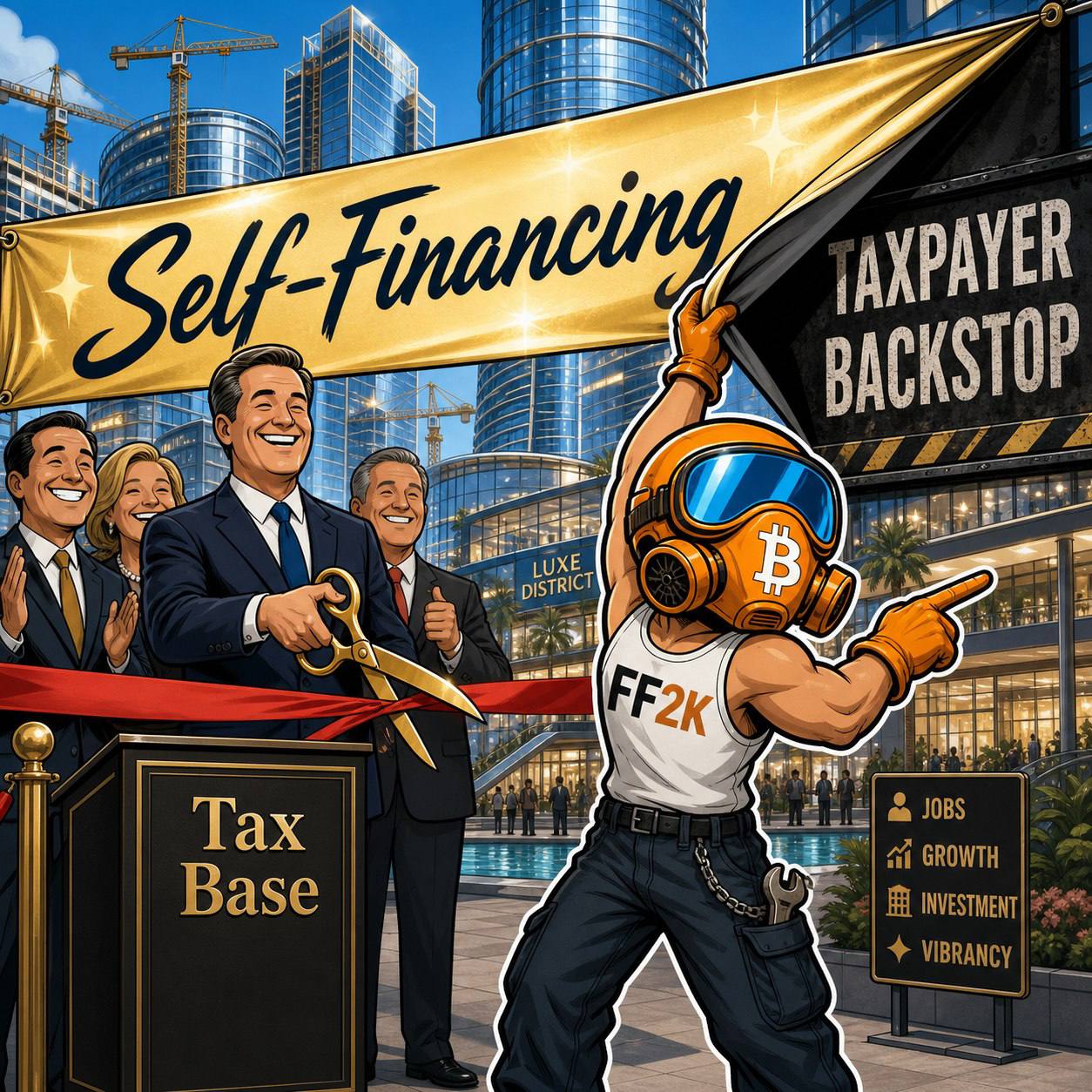
Useful things got built. The subway extension exists. Buildings exist. Public space exists. Rich people have places to stand near expensive salads. But the pitch matters.
"Self-financing" is not just accounting language. It is a sedative. It tells citizens they can have a mega-project without a tradeoff, tells politicians they can be builders without being tax hikers, and tells developers the public sector will help create the value, absorb part of the risk, and still call it economic development.
That is how cities get talked into billion-dollar bets while being told they are not gambling.
New York has other flavors of the same disease. One Seaport / 161 Maiden Lane ran luxury condo economics into engineering, lending, litigation, and delay. That one matters because it gets past the marble lobby and down into the dirt. A tower can be sold in the sky, but it still has to be founded in the ground.
When capital is removed from consequence, shortcuts start looking rational. Save money on the foundation. Stretch the height. Push the envelope. Count the future sales. Assume the exit. Then, if the thing leans, settles, leaks, stalls, or ends up in court, everybody acts like the building betrayed the model.
No. The model betrayed the building.

Billionaires' Row gives us another version: ultra-luxury buyers discovering that a $100 million address can still come with alleged defects, repairs, and the world's most expensive HOA headache. The Chrysler Building is the old-money version: a legendary asset eaten by ground leases, capex, vacancy, and landmark rules.
Miami is the other side of the machine.
There, the pitch is not always public subsidy first. Sometimes it is brand alchemy.
Take the Porsche Design Tower in Sunny Isles Beach. It is real, completed, and visually absurd in the exact way luxury marketing loves. The pitch is not "buy a condo." The pitch is "buy an identity." A patented car elevator carries your vehicle up to your private sky garage. Your Ferrari gets a better view than most American families.

Or Aston Martin Residences in downtown Miami: 66 stories, 391 ultra-luxury condos, sports-car language poured into a waterfront tower. The official release celebrates it as Aston Martin's first residential real estate project. Translation: the brand is part of the product.
Again, I am not saying these buildings are failures. I am saying they reveal the formula.
The building is a financial instrument wearing a brand costume.
The name does work the concrete cannot do by itself. Porsche. Aston Martin. Trump. Armani. Bentley. Whatever badge the marketing department can weld to the lobby. A licensing agreement or design partnership turns square footage into mythology. Buyers are purchasing a story about themselves, funded by cheap capital, pre-sales, private equity, construction loans, and the belief that luxury demand will keep rising forever like an elevator in a sales brochure.
That belief may be true for some projects. Until it is not.
And that is the point. The people who make the project happen are often not the people who have to live with it fifty years later.
The developer can sell out. The brand can license and move on. The politician can cut the ribbon and run. The banker can securitize, refinance, or exit. The construction team can finish the punch list. The sales office can close.
Then the building remains.
It remains through insurance spikes, salt air, changing work habits, lawsuits, special assessments, half-empty retail bases, and reserves that looked fine when the renderings were printed.
These are not just architectural statements. They are time bombs with concierge desks.
And the failure modes are not mysterious. The foundation is too clever. The curtain wall leaks. The elevator system becomes a lawsuit with buttons. The amenities arrive late or never. The condo board inherits repairs the sales model treated like someone else's weather. The retail base goes half dark. The office tenant never comes back. The debt gets extended because nobody wants to admit the building is worth less than the paper wrapped around it.
That is where the ugly math begins.
A bad building can be too expensive to own and too expensive to remove. The land underneath it may be valuable, but not valuable enough to justify demolition, legal cleanup, debt fights, environmental work, replacement plans, and the political circus of admitting the skyline has dead weight in it.
So the building sits.
Maybe it limps along for twenty years. Maybe the debt gets refinanced four times. Maybe inflation slowly eats the original mistake until the land is finally worth enough, in cheaper future dollars, to make tearing it down pencil out. Not because the tower succeeded. Because the money failed slowly enough that everyone could pretend it was a cycle.

That is the part nobody puts in the brochure: sometimes the exit strategy is waiting for inflation to make the original stupidity small enough to bury.
New York wants the tax base. Miami wants the tax base. Every local government wants the tax base. That is the political addiction.
If a developer says, "Let me build a tower and your assessed values will rise," city hall hears music. More property tax. More jobs press releases. More campaign-friendly crane photos. More proof the city is "world class," which apparently means having enough glass rectangles to blind low-flying aircraft.
So governments approve density, infrastructure deals, tax abatements, special districts, bonds, and zoning changes. Sometimes those tools are defensible. Cities need development. Infrastructure has to be financed somehow. Not every public-private partnership is a grift.
But local governments routinely underprice the long-term public risk because the short-term revenue story is too attractive.
They do not ask hard enough: what if the demand is borrowed from the future? What if the tenants are just moving from somewhere else in town? What if the infrastructure costs more than projected? What if climate, insurance, and maintenance costs rise faster than the condo board expected? What if the project's highest and best use is only highest and best during a credit bubble?
Those questions are boring.
Ribbon cuttings are not.
So the system keeps building.
It builds malls that are obsolete before the debt is paid off. American Dream in New Jersey is practically a theme park for that sentence. It builds office districts right before office demand changes. It builds branded towers on coasts where carrying costs keep rising. It builds billionaire fantasies and calls them economic development.
This is debt-based money made visible. Not in a textbook. In a skyline.
Debt does not only create currency. It creates incentives. It rewards present value. It makes tomorrow's cash flows look spendable today. It lets everyone involved convert a forecast into a fee.
Stack enough future rent, tax revenue, condo sales, tourism, and prestige into a model, and the building becomes "financeable." Once it is financeable, it becomes politically real.
That is the trick.
The tower exists first in debt. The concrete arrives later. Then everyone treats the concrete like proof the original assumptions were sane.
But buildings are not proof. Buildings are commitments.
A city that approves a project is not just approving height. It is approving future obligations: traffic, transit, utilities, policing, flood mitigation, emergency services, maintenance politics, tax exposure, and the signal that this is what the city values.
A 60-story luxury tower is not neutral. A subsidized mega-district is not neutral. A branded billionaire building is not neutral. These things reorganize land, incentives, and public attention around people who can turn borrowed money into concrete and call it progress.
Then we wonder why regular people look around and feel like the city is no longer being built for them.
They are not wrong.
A city can survive rich people. It cannot survive letting rich people's financing models become its urban plan.
The problem is not height. Height can be beautiful. Density can be useful. A city should grow upward when it makes sense.
The problem is when height becomes a way to launder leverage into civic pride.
Hudson Yards is not offensive because it is tall. It is offensive because "self-financing" became a way to sell public risk as free development.
Porsche Design Tower is not offensive because it is luxurious. It is revealing because the luxury proposition is so naked: your car gets a penthouse too.
Aston Martin Residences is not offensive because it uses a brand. It is revealing because the brand is the product.
Trump-branded towers are useful examples for the same reason. In many cases, the value is not in who physically builds the thing, but whose name turns financing and sales into a story buyers recognize.
The name goes up first. The future gets billed later.
And local governments keep playing along because every one of these projects promises the same thing: jobs, taxes, prestige, growth, investment, momentum. The language is positive. The downside is technical. The benefits are photographed. The risks are footnoted.
That is backwards.
The risk is the story.
If a project only works with cheap debt, tax favors, optimistic absorption, branded fantasy, public subsidy, and politicians desperate for ribbon cuttings, maybe it does not work. Maybe it is not a development. Maybe it is a liability wearing mirrored glass.
And if the people who profit most at the start have the easiest path to leave before the hard years begin, the system is not accidentally short term. It is designed to be short term.
Developers build from past success. Politicians approve from projected tax receipts. Lenders finance from modeled cash flows. Buyers buy from status and appreciation. Everyone points to yesterday's skyline and says, "See? Do it again."
But the future is not obligated to honor the spreadsheet.
Office demand changes. Insurance changes. Climate changes. Interest rates change. Work habits change. Retail habits change. Foreign money changes. Maintenance costs change.
Concrete does not change easily.
And this is not only a skyscraper problem. Silicon Valley is the same story turned sideways.
Santa Clara Valley used to be orchards, packing houses, canning plants, rail spurs, and farm towns. It made physical things and moved them through physical systems. Prunes, apricots, cherries, peaches. Real dirt. Real labor. Real output. Then the Valley became a technology mythology machine, and the land underneath it became too expensive for almost anything normal to survive.
Now you have office campuses priced like temples, cities dependent on tech payrolls, and public budgets built around the assumption that the next wave of money will always arrive richer than the last one. But if engineers can work from home, if teams can scatter, if companies can hire in cheaper states, if artificial intelligence lets the same firm do more with fewer people, then a glass office park in one of the most expensive tax jurisdictions in the country starts to look a lot like a luxury tower with an empty retail base.
The old reason for cities was not vibes. Ports mattered. Factories mattered. Rail mattered. Warehouses mattered. Markets mattered. You had to be near the physical choke points because commerce had a body.
A lot of that is gone now. Not all of it. Hospitals still anchor cities. Universities still anchor cities. Government still anchors cities. Some finance, law, research, entertainment, and medical ecosystems still need density. But the old commercial logic has been hollowed out. The new city often survives on credentials, medicine, debt, regulation, tourism, and real estate inflation.
That is not organic growth. That is money growth.
When the money is new, every building looks smart. When the money gets expensive, the same building starts looking like a storage unit for bad assumptions.
So we are left with monuments to assumptions.
Some will thrive. Some will limp along. Some will sue themselves into headlines. Some will need subsidy. Some will be converted. Some will be torn down by people who were not in the room when the thing was approved.
And when that happens, the same people who called it progress will call the cleanup "revitalization."
That is the part worth watching.
Because the skyline gets the glory.
The sidewalk gets the bill.
Viewing references / YouTube rabbit hole
These are not formal citations for every claim in the essay. They are the video trail and public reference shelf behind the piece:
- Detroit Renaissance Center redevelopment/demolition coverage: "Detroit's Renaissance Center to undergo redevelopment" — https://www.youtube.com/watch?v=30QeH1zr-V8
- Detroit/RenCen background: "Inside the $1.6B Demolition of Detroit's Renaissance Center" — https://www.youtube.com/watch?v=FAXKvenryg8
- Detroit/RenCen background: "Detroit's $1.4B Tower That Broke the RenCen" — https://www.youtube.com/watch?v=F_I9VOzTF90
- Hudson Yards public-finance background: "Did New York Waste $25 Billion on a Ghost Town?" — https://www.youtube.com/watch?v=YXa3qE0iWrY
- Hudson Yards public-finance background: "Everything Wrong w/ Hudson Yards: A Visit feat. Sam Stein" — https://www.youtube.com/watch?v=_VoQsEImKHg
- Hudson Yards source shelf: Center for New York City Affairs, "Too Good to Be True: Lessons Learned from Hudson Yards" — http://www.centernyc.org/too-good-to-be-true
- 161 Maiden Lane / One Seaport engineering background: "161 Maiden Lane: NYC's Half-Built Skyscraper" — https://www.youtube.com/watch?v=oJLAkZisGv8
- 161 Maiden Lane / One Seaport engineering background: "Inside New York City's Unfixable Skyscraper" — https://www.youtube.com/watch?v=tHRDieIw3_Y
- 161 Maiden Lane / One Seaport engineering background: "Engineer Explains the Leaning Tower of NY" — https://www.youtube.com/watch?v=hIe0MWNvZBQ
- 161 Maiden Lane / One Seaport source shelf: The B1M, "The Leaning Tower of New York City" — https://www.theb1m.com/video/the-leaning-tower-of-new-york-city
- Silicon Valley land-use background: "How a Farming Town Became the Tech Capital of the World" — https://www.youtube.com/watch?v=xMNNETA_9Aw
- Silicon Valley / remote-work pressure background: "Why Nobody Wants to Move to Silicon Valley Anymore" — https://www.youtube.com/watch?v=1BfGJknj-g8