 Mutley · Mutley · August 25, 2026
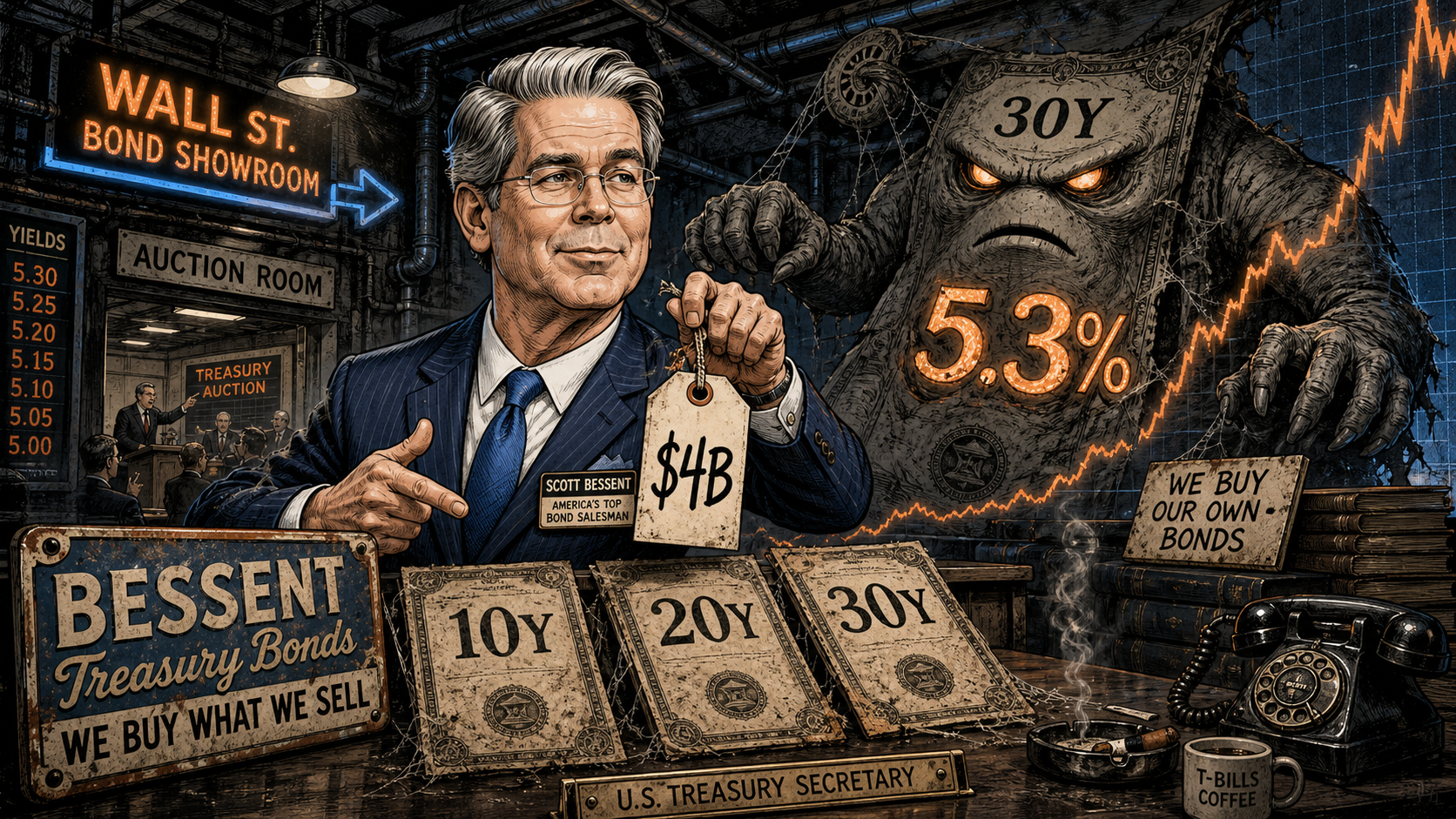
Scott Bessent calls himself America’s top bond salesman.
Now the salesman is buying back his own product.
On August 19, the Treasury Department announced that it would at least double the size of its buyback operations for older Treasury debt in the 10-to-30-year range. The old ceiling was $2 billion per operation. Beginning September 9, Treasury’s announced operation size will be at least $4 billion, although the amount actually accepted can be lower.
Treasury calls it “liquidity support.”
Wall Street calls it what it saw: Washington stepping into the long end after the 30-year yield climbed above 5.3 percent and started making everyone with a mortgage calculator sweat through his shirt.
The official language is not false. It is just wearing enough cologne to cover the fear.
First, What the Hell Is a Bond Buyback?
Treasury is not buying back “the yield.” It is buying back actual government bonds—mostly older, less-traded bonds known as off-the-run securities.
When Treasury buys those bonds, it retires them. That reduces the amount of long-dated debt floating around, gives dealers a clean exit from positions that are harder to trade, and frees balance-sheet room for them to keep making markets.
It also creates additional demand for long bonds.
More demand means higher bond prices. Higher bond prices mean lower yields. Bonds are annoying that way: price and yield sit on opposite ends of the seesaw.
So Treasury can call this a plumbing repair—and some of it is—but the market consequence is obvious. Buying long bonds is a way to lean against rising long-term rates.
This is not Federal Reserve quantitative easing. The Fed can create reserves and enlarge its balance sheet. Treasury cannot wave a wand and print the money for these purchases. It must use cash and account for the buybacks as another financing need.
In plain English, Treasury retires long-dated bonds and finances the added cash need through its overall issuance program. Treasury says it chooses the mix of bills and coupons in total, although unexpected short-term borrowing changes are still largely absorbed with bills.
That is not debt destruction.
And Treasury explicitly says the program is not intended to change the maturity profile of the debt.
But each long-end operation still removes interest-rate risk from that sector without mechanically replacing it with equivalent long issuance. Call it what it is: a limited duration trade wearing a maintenance uniform.

Why Bessent Cares About the Long End
The Federal Reserve controls the overnight policy rate. The market controls the 10-year and 30-year yields, and those are the rates that crawl into the real economy.
The 10-year helps set mortgage rates. Long Treasury yields influence corporate debt, car loans, construction, capital spending, stock valuations, and the government’s future interest bill.
When the long end rises, housing gets colder, refinancing gets uglier, companies pay more to borrow, and Washington’s debt machine starts eating a larger portion of the budget.
Bessent has been unusually open about caring.
In February 2025, he said he and President Trump were focused on the 10-year Treasury rather than demanding that the Fed cut short-term rates. His pitch was that deregulation, lower energy costs, fiscal restraint, and non-inflationary growth would naturally pull long rates down.
Later he called Treasury yields a barometer of his success as the nation’s top bond salesman. Lower Treasury rates, he said, would mean cheaper mortgages, car payments, and corporate borrowing.
Fair enough.
But once you declare the scoreboard, you do not get to complain when it lights up the wrong number.
The 30-year yield climbed into territory not seen in roughly two decades. Bessent responded by doubling long-end buybacks, then went on television and said Treasury could buy even more because current yields do not reflect the “underlying fundamentals.”
That is the bond salesman telling the customers they have priced the merchandise incorrectly.
The customers briefly nodded, bought some bonds, and then pushed yields mostly back up.
The Market Is Not Confused
Long-term bond yields are not mysterious weather.
They are a price for time, inflation, uncertainty, and the risk that Washington will spend the next thirty years treating arithmetic like a partisan rumor.
Investors lending money for decades want compensation for expected short-term rates. They want protection from inflation. They demand a term premium for locking up capital. And when deficits are enormous and Treasury must keep issuing mountains of debt, they want a better price for absorbing the supply.
Add heavy corporate borrowing for AI infrastructure, uncertainty about the Fed’s inflation discipline, and a federal debt load already above $40 trillion, and the market’s message is not hard to translate:
If you want our money for thirty years, pay us.
Bessent believes the market is overshooting—that inflation and deficits will improve, rates will eventually fall, and locking taxpayers into today’s long-term yields would be stupid.
He may be right.
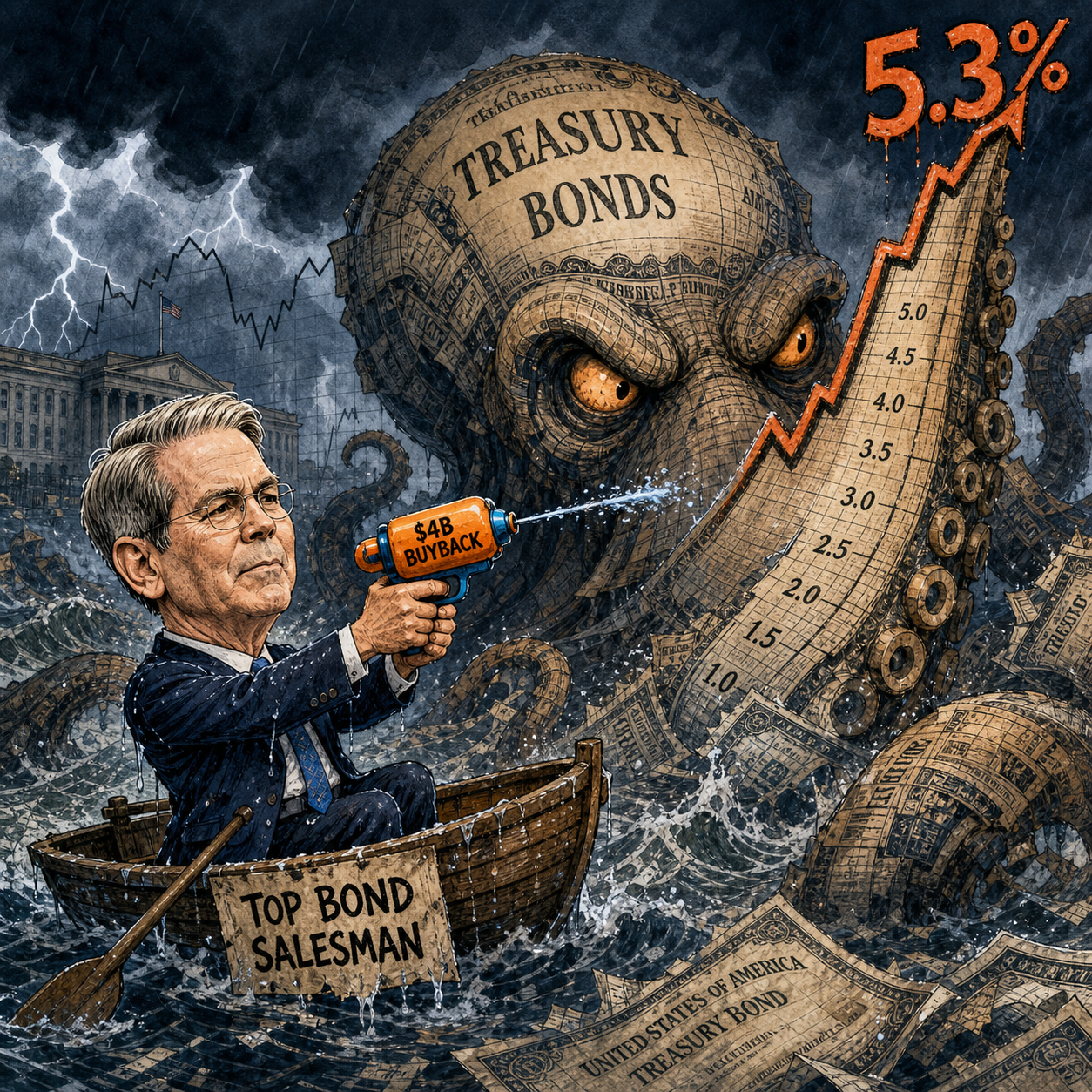
But even an announced $4 billion buyback operation is a squirt gun beside a Treasury market measured in tens of trillions and annual government borrowing measured in trillions. It can improve liquidity. It can surprise short sellers. It can break the momentum of a disorderly selloff for an afternoon.
It cannot repeal fiscal arithmetic.
The Part That Bites
Before Bessent ran Treasury, he criticized Janet Yellen for relying too heavily on short-term debt. His argument was that she was holding down long-term yields and easing financial conditions for political reasons.
Then he got the keys.
In June 2025, when asked why Treasury was not issuing more long-term debt, Bessent said it made no sense at elevated yields. The time to lock in long-term financing, he said, was back in 2021 or 2022, when rates were cheap.
That answer was economically sensible.
It was also an admission that the lever he criticized from outside looked awfully useful from behind the desk.
Now he is expanding a buyback program launched under Yellen to remove more long-duration bonds from the market. Treasury says the program is not meant to change the debt’s overall maturity profile, and its financing can include both bills and coupons.
The exact transactions are different. The political incentive is not.
Yellen’s issuance mix and Bessent’s enlarged long-end buybacks can both reduce the amount of duration the public must absorb at a given moment. Both can put downward pressure on long-term yields. And to the extent that the replacement financing lands shorter, taxpayers inherit more refinancing risk if short-term rates stay high.
Yesterday’s manipulation becomes today’s prudent debt management once your name is on the office door.
Funny how the stationery clears the conscience.
The Bet Underneath the Spin
Bessent’s broader debt-management posture amounts to a trade with the nation’s balance sheet.
He is betting that today’s long-term yields are temporarily too high. He has said it makes little sense to ramp up long-term issuance at current yields. The practical posture is to fund flexibly now, wait for inflation and rates to fall, and issue more duration later if the price improves.
If he is right, it is smart. Treasury avoids locking in expensive thirty-year money, market plumbing improves, and taxpayers refinance later at lower rates.
If he is wrong, the government keeps rolling more debt at short maturities, refinancing risk grows, interest costs remain brutal, and every future auction becomes another appointment with the same dentist.
Worse, if the market decides Bessent is defending a particular yield level, traders will test it. A Treasury secretary can frighten a few shorts. He cannot credibly promise to buy enough bonds to overpower inflation, deficits, and global capital flows without turning routine debt management into something much larger and much uglier.
The actual cure is boring and politically radioactive: credible inflation control, smaller structural deficits, predictable issuance, and a federal government that stops confusing new debt with new wealth.
Buybacks can keep the pipes from clogging.
They cannot fix the drunk who keeps flushing socks.
Bessent knows this. He is not an idiot. He is a bond trader standing between an administration that wants lower rates, a Congress that loves spending, and a market that has begun charging admission to the fantasy.
So he is buying time.
Short time, naturally.
- Mutley