 FF2K · The Bunker Desk · June 27, 2026
There is a story bitcoiners tell themselves about corporate adoption.
Every time a publicly traded company adds bitcoin to its balance sheet, every time an ETF logs another record week of inflows, every time a CFO appears on CNBC to explain a digital gold strategy, the number goes up. The orange line on the chart goes up. The legitimacy score goes up. The narrative gains altitude.
And all of that is real.
Corporate adoption helped break Bitcoin out of the cypherpunk basement and into the boardroom. That mattered.
But there is a Catch-22 sitting underneath the celebration, and it is worth staring at directly: the thing corporate adoption promotes is not the thing corporate adoption delivers.
Paper Bitcoin Is Not Bitcoin
When you own shares in a company that holds bitcoin, you do not hold bitcoin.
When you own a bitcoin ETF, you do not hold bitcoin.
When a pension fund, a sovereign wealth fund, or a corporate treasury acquires BTC through a custodian, layered inside a financial structure, wrapped in counterparty relationships and board-level approval processes, the actual coins exist somewhere. They are just not accessible to the people the narrative says they are protecting.
The whole value proposition of Bitcoin — the one Satoshi wrote down, the one that survived 15 years of attack — is individual monetary sovereignty.
The ability to hold value without a trusted third party. To transact without permission. To preserve wealth outside the reach of boards, creditors, regulators, and management decisions.
A shareholder gets exposure to bitcoin's price.
They do not get what bitcoin is.
That is not a semantic distinction. That is the entire point.
The Billboard Problem
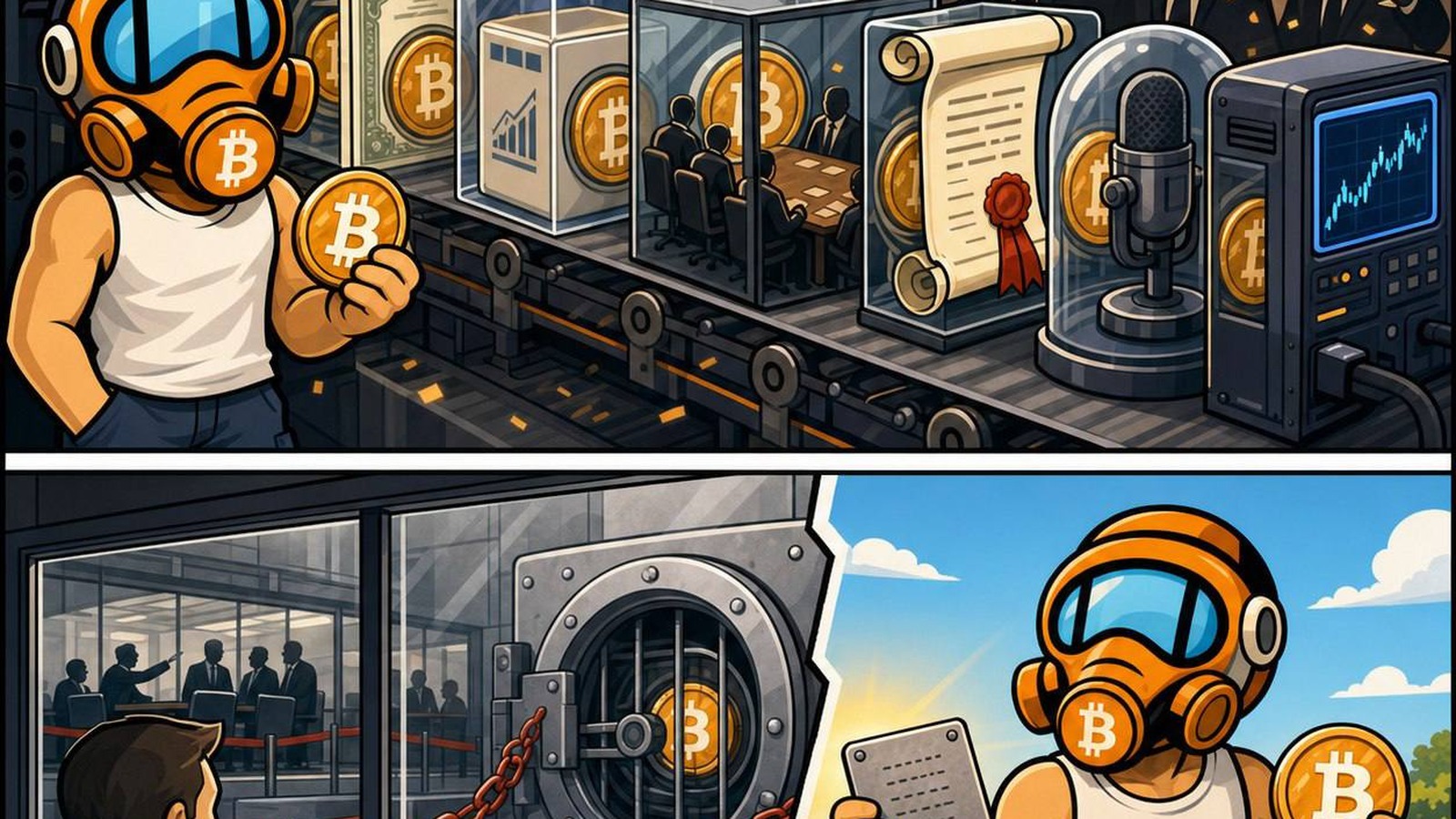
Think of corporate bitcoin as a billboard.
A big, expensive, well-lit billboard on the highway. Millions of people see it. They think: Bitcoin must be legitimate. Smart money is buying it. It is working.
Some of them go home and buy an ETF. Some of them buy shares in the company. The price goes up. The billboard gets bigger.
But a billboard for a place is not the place.
Bitcoin's core offer is an exit from the traditional financial system's dependency architecture — the one where your savings are subject to someone else's decisions, where your account can be frozen, where your currency can be inflated, where your wealth is always ultimately held by a custodian you are just hoping is trustworthy.
Bitcoin, held in self-custody, exits that system entirely.
Corporate bitcoin wrappers live inside that system.
They use its legal structures, its custody arrangements, its debt markets, its regulatory frameworks. In a crisis — the very kind of crisis Bitcoin was designed for — those wrappers will behave like everything else inside the system: capital controls, redemption gates, board votes, court orders, and the warm customer-service voice telling you your request is very important.
The people who need Bitcoin the most, in the moments they need it the most, may discover that what they owned was exposure.
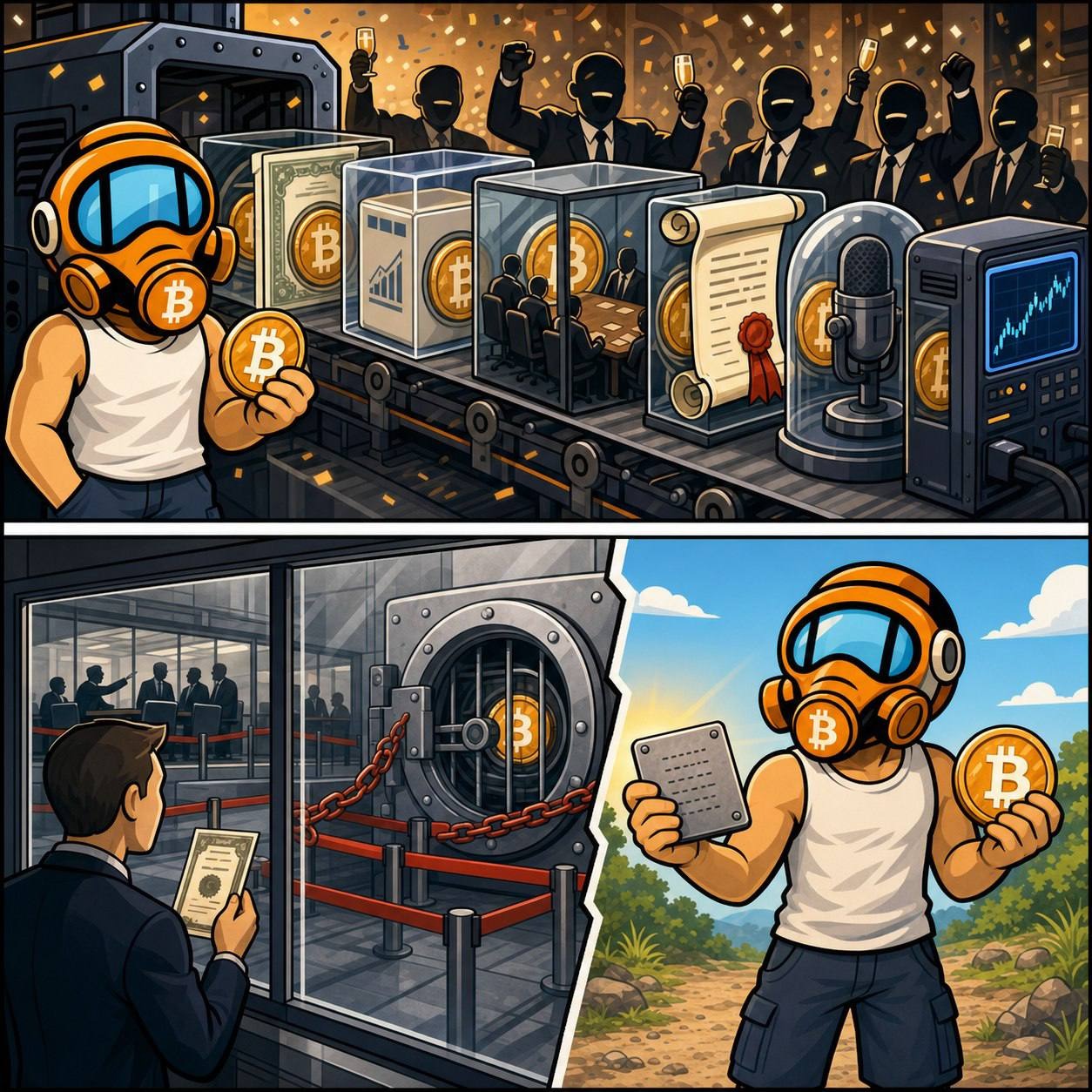
Not sovereignty.
The Market Is Starting to Notice
The distinction between bitcoin exposure and bitcoin ownership is not just philosophical. It has practical implications that are beginning to surface in how sophisticated holders are thinking about the space.
There is a growing recognition that the bitcoin price and the bitcoin network are not the same thing.
Price can be driven by institutions. The network is built by individuals who take custody seriously, run nodes, hold keys, and transact peer-to-peer when it matters.
A billionaire company's treasury hold does not add a single person to the self-sovereign class.
It does not onboard anyone to the philosophy.
It parks capital in an asset.
That is fine.
But it is not the revolution.
It is the revolution's marketing department.
The question is not whether corporate adoption is good or bad for Bitcoin.
The question is whether it obscures what Bitcoin is actually for.
And whether people, when the time comes, will have actually prepared — or will discover they owned a wrapper when they thought they owned the exit.
The Takeaway
Self-custody is the product.
Everything else is advertising.
Buy the billboard if you want.
But do not confuse it with the building.
The simplest test is still the best one: Can you send it? Can you hold it without asking permission?
If not, what you have is exposure.
And exposure is not sovereignty.
- FF2K